CPD RESOURCE
NMC revalidation guide: CPD, practice hours, feedback and reflective accounts
This guide is for nurses, midwives and nursing associates preparing for NMC revalidation. It explains the main record areas in plain English, with links to official NMC guidance. HandyCPD can help you organise CPD, feedback, practice hours, reflections and evidence digitally, while you stay responsible for checking, editing and approving every record.
HandyCPD is not affiliated with or endorsed by the NMC. It does not replace official NMC forms, MyNMC submission, reflective discussion, confirmation or your professional responsibility for revalidation.
Resources support CPD learning and organisation. You review and approve every record.
This page focuses on NMC registrants in the UK. Revalidation runs on a three-year cycle from your last renewal or from when you joined the register. Always verify current NMC revalidation guidance before you submit your application.
What NMC revalidation asks you to keep track of
NMC revalidation is a structured way to show that you remain fit to practise. Over each three-year period you need to maintain records of CPD, practice hours, practice-related feedback and written reflective accounts, then complete further steps such as health and character declarations, professional indemnity arrangements, a reflective discussion, confirmation and your online application through MyNMC.
This guide focuses on the record-keeping areas where HandyCPD is most useful: logging learning, organising evidence, drafting reflections and tracking practice hours and feedback. For the full process, including reflective discussion and confirmation, see the NMC requirements pages.
Reflective discussion and confirmation
After preparing your records, you will discuss your reflective accounts with another NMC registrant and have a confirmation discussion with a confirmer. The NMC provides mandatory forms for these steps. HandyCPD can help you prepare supporting material, but it does not replace those discussions or official forms.
CPD hours and participatory learning
You must complete 35 hours of CPD relevant to your scope of practice over the three-year period. At least 20 of those hours must include participatory learning: activity that involves interaction with one or more other professionals, in person or virtually. The NMC does not prescribe specific CPD types; you decide what supports your development. See NMC CPD requirements.
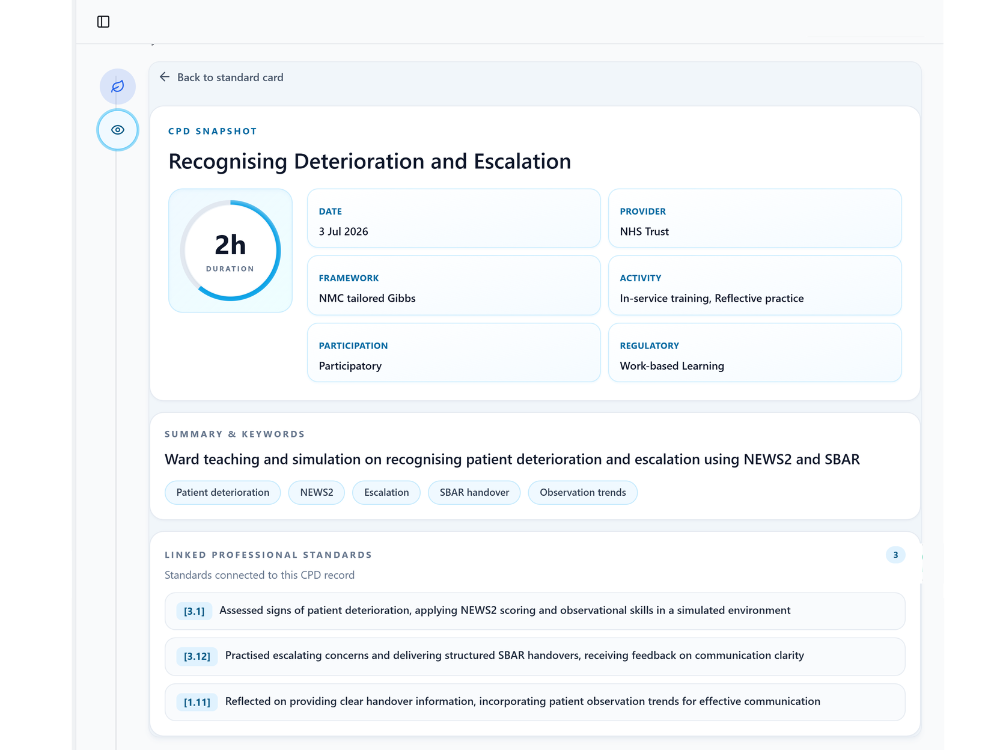
In our fictional example, a registered adult nurse attends ward-based teaching and simulation on recognising deterioration, reviewing NEWS2 trends, escalating concerns and giving structured SBAR handovers. That learning can count towards CPD when recorded accurately with dates, hours and evidence.
HandyCPD helps you capture learning from a brief note through to a filed CPD record with duration, participatory status, keywords and linked standards. See the CPD Logging feature for how Plant a Seed, review and filing work in the app.
CPD Snapshot: a filed learning record
After review, a filed CPD Snapshot brings together duration, participatory status, summary keywords and linked professional standards. Check every field before you rely on the record or use it to support reflection or export.
Written reflective accounts
You must prepare five written reflective accounts over the three-year period. Each account must refer to an instance of CPD and/or practice-related feedback and/or an event or experience in your professional practice, and explain how it relates to the Code. See NMC written reflective accounts requirements.
Important: the NMC states that you must use the official reflective accounts form to record your five written reflective accounts. HandyCPD can support drafting, structuring and review in the app, but you remain responsible for transferring approved content to the mandatory NMC form and for what you submit.
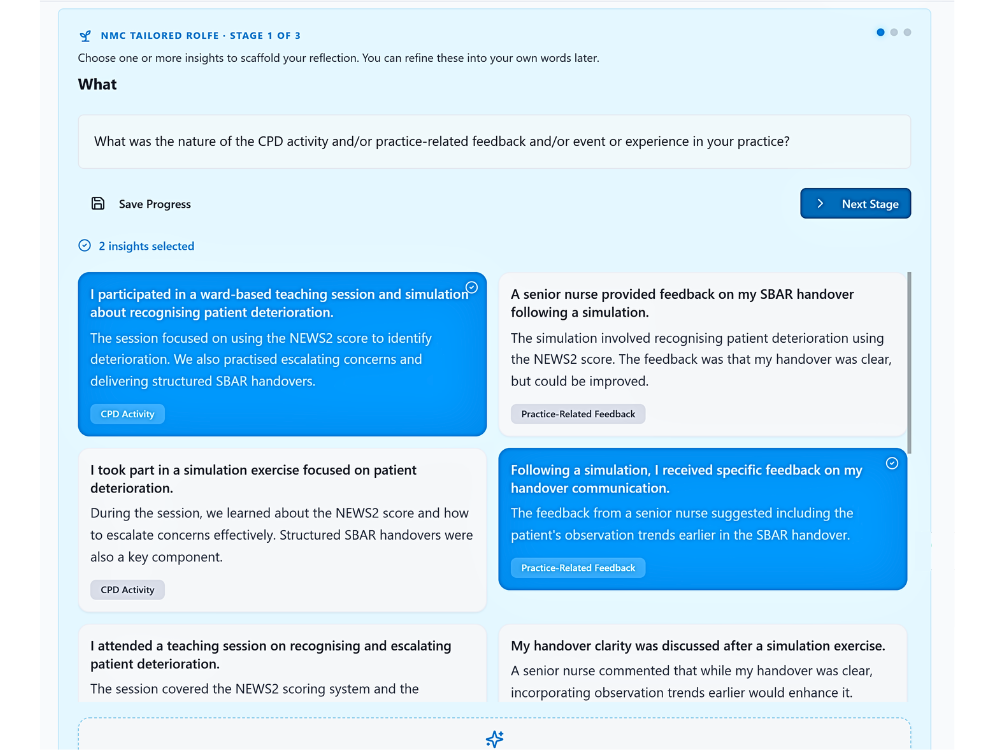
For NMC registrants, HandyCPD offers NMC-tailored reflection models based on Gibbs and Rolfe. The Reflection Engine provides palettes of prompt cards and editable draft ideas that can be refined into a clearer, more personal reflection. These supports do not replace your professional judgement or the official NMC reflective account form. You can also read our Gibbs reflective cycle guide and Rolfe reflection model guide for further information on these models. See the Reflection Engine feature and our how to write a CPD reflection guide for broader reflection support.
Reflection Engine: NMC-tailored prompts
Select insight cards that reflect your learning, then refine the draft in your own words. In the fictional example, the nurse reflects on ward teaching, NEWS2, escalation and SBAR handovers, including feedback about including observation trends earlier in the handover.
Practice hours
You must have practised for a minimum number of hours over the three-year period. For a single registration as a nurse, midwife or nursing associate, the minimum is 450 hours. Dual registration requires 900 hours. Triple registration requires 1,350 hours. If you hold more than one registration, check the full table on the NMC practice hours page.
Practice hours should reflect your current scope of practice. They can include direct care, managing teams, teaching and helping to shape or run a care service. The NMC recommends using its practice hours log template; HandyCPD helps you maintain structured hours records for review, but does not replace the official template where the NMC expects it.
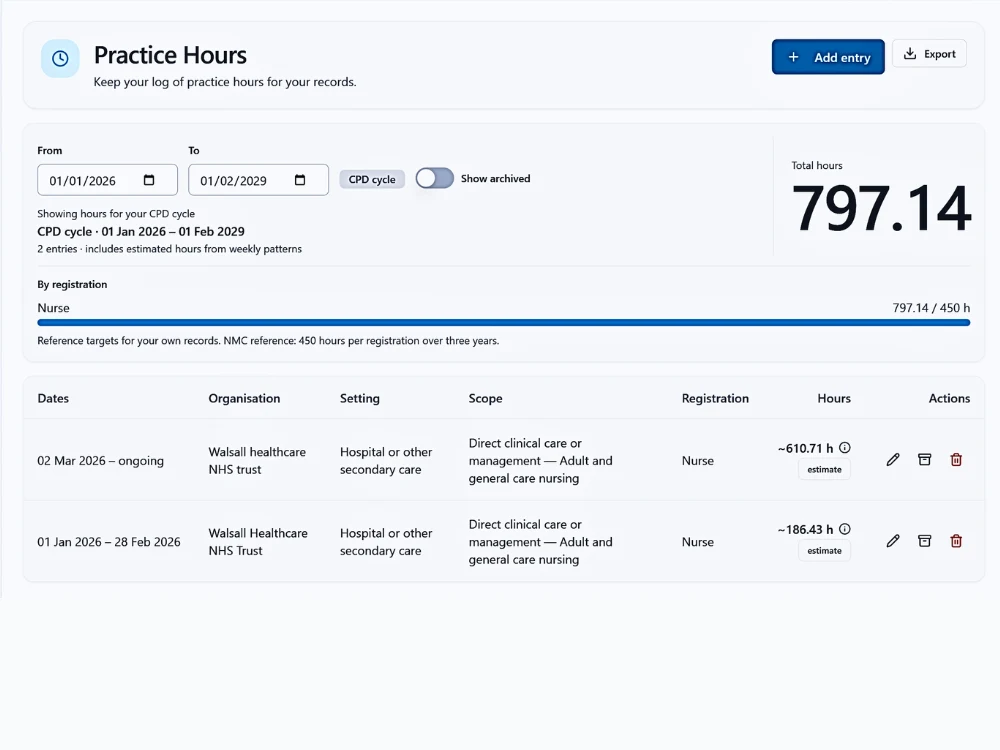
See Practice Hours Logging for cycle totals, role-based estimates and NMC-oriented fields when your profile is set as a nurse or midwife.
Practice hours overview
Review manual entries and role-based estimates together so you can see your position across a chosen period or revalidation cycle. This supports organisation and review; it does not prove compliance or submit records to the NMC.
Practice-related feedback
You must obtain five pieces of practice-related feedback over the three-year period. Feedback can be written or verbal, formal or informal, and may come from patients, colleagues, management, appraisals or team performance reports. The NMC recommends keeping a note of the content and how you used it to improve practice. See NMC practice-related feedback requirements.
In the fictional example, a senior nurse gives feedback that the nurse's SBAR handover was clear, but observation trends could be included earlier. Recording that feedback promptly helps when you later write reflective accounts linked to the Code.
See Feedback Logging for recording, filtering and linking feedback alongside CPD and reflection workflows.
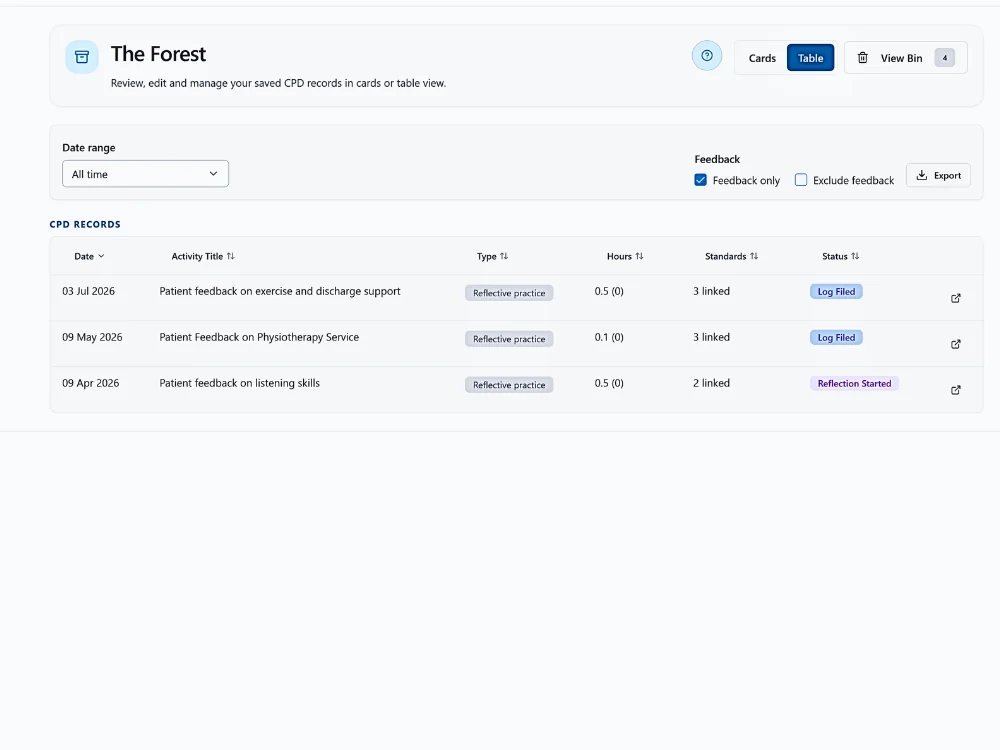
Feedback records table
Keep feedback entries organised and linked to related CPD where useful. Avoid patient-identifiable, colleague-identifiable or unnecessary confidential detail in notes or drafts.
Evidence and portfolio organisation
CPD records should include evidence that you undertook the activity. You may also store certificates, notes, exported reflective PDFs and copies of official NMC forms in one portfolio. The NMC recommends CPD and feedback log templates; the reflective accounts form is mandatory for the five written accounts.
HandyCPD helps you attach evidence, export PDFs when needed and keep related records connected. It does not replace mandatory NMC forms or MyNMC submission. See Evidence Library and CPD PDF Export.
Mapping CPD and reflection to the NMC Code
When you record CPD, the NMC expects you to identify the part of the Code most relevant to the activity. HandyCPD standards mapping can suggest links between logged CPD, feedback and reflections and professional standards, including the NMC Code. Suggestions are supportive; you review and approve every mapping.
CPD Analytics can help you see themes and coverage across logged activity and feedback over time. This is insight for your own professional development planning, not proof of revalidation compliance. See Standards Mapping and CPD Analytics.
A simple HandyCPD workflow
- Plant a Seed: capture brief notes after teaching, simulation or feedback while details are fresh.
- Review and organise: check the structured CPD record, hours, participatory status, keywords and Code links.
- Record feedback and practice hours where relevant to the learning or period of work.
- Reflect where useful: use NMC-tailored prompts, edit the draft and approve only what accurately represents your learning.
- File evidence and export: attach supporting material and export PDFs when needed; complete official NMC forms separately as required.
How AI can support NMC revalidation records
HandyCPD supports CPD recording and reflection drafting. It does not replace professional judgement. You remain responsible for reviewing, editing and approving all records before relying on them or sharing them with the NMC, a confirmer, an employer or auditor.
AI in HandyCPD can help summarise learning notes, suggest structure for CPD records and scaffold reflection drafts from insight cards. That can save time when records would otherwise stay as rough notes.
What AI should not do
- Replace your professional judgement or write finished reflective accounts without your review.
- Submit records to the NMC, complete MyNMC applications or replace mandatory official forms.
- Encourage uploading patient-identifiable or unnecessary special-category data.
- Guarantee that any record will meet NMC, employer or confirmer expectations.
Important note about NMC revalidation and professional responsibility
Good revalidation preparation is grounded in honest records of learning, practice and reflection. Whether you use HandyCPD, paper templates or another tool, you remain accountable for what you record, what you share with a confirmer and what you submit through MyNMC.
HandyCPD is not affiliated with or endorsed by the NMC. It helps organise records and draft, review and export supporting material. It does not replace official NMC forms, reflective discussion, confirmation or professional responsibility for revalidation. HandyCPD does not guarantee that any record format, wording or evidence will be accepted by the NMC, your employer or any other body.
Ready to organise NMC revalidation records you can review and approve?
Log CPD, record feedback and practice hours, and build structured reflections with drafts you edit before filing.
30-day Pro trial. No card required.