
Standards Mapping
Standards mapping you can trust
Mapping CPD to professional standards can feel overwhelming, especially when frameworks are long, wording is formal and you are trying to reflect on real learning rather than tick boxes. HandyCPD starts with verified regulator standards where they are available, then gives other professionals a clear route to keep CPD organised.
Suggested standards links support reflection and organisation. You review, edit and approve every record before filing or sharing it.
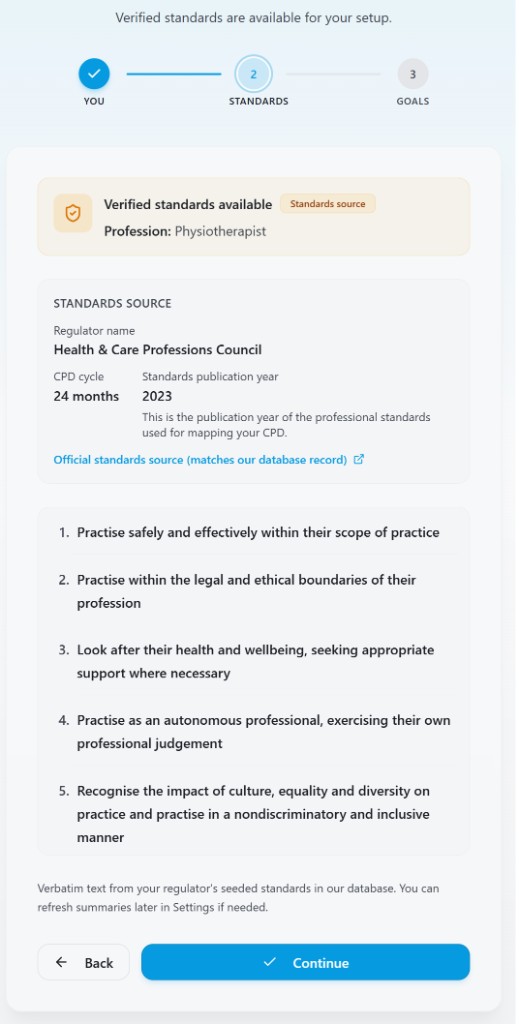
Verified standards library
In HandyCPD, verified means built from published regulator frameworks and checked into the product library. It does not mean regulator endorsement or approval, and HandyCPD does not guarantee that regulators will accept your CPD records.
When your regulator is already mapped in HandyCPD, your CPD can be linked to standards built from published regulator frameworks and checked into the product.
Current verified coverage includes:
- HCPC professions
- NMC nurses and midwives
- Social Work England
- Scottish Social Services Council
- Social Care Wales
The example screenshots below use HCPC physiotherapy standards. Other verified regulators follow the same pattern in HandyCPD.
How it appears in CPD records
When you file a CPD log, HandyCPD can suggest up to three relevant standard items from your framework. On the detailed CPD log card, each linked standard is shown with the reference code and the full standard text from the verified library, so you can check the original wording before approving the record.
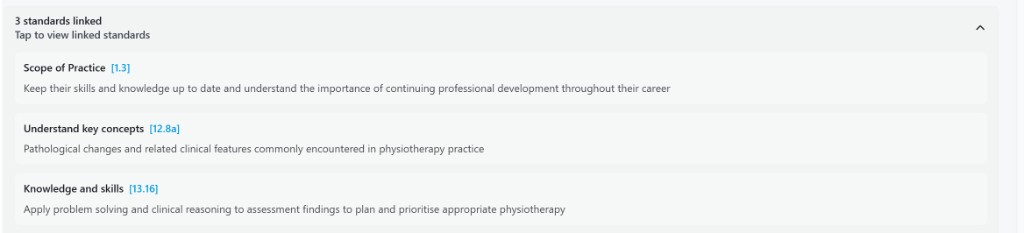
Suggested relevance for review
In CPD Snapshot and related views, HandyCPD may also show a shorter suggested relevance line, explaining how and why a standard item may relate to your learning. This phrasing supports your review; it is not official regulator text and may differ from the verbatim library entry. Edit anything inaccurate before relying on the record.

Who standards mapping can help
Standards mapping can support HCPC registrants, NMC nurses and midwives, Social Work England registrants, Scottish Social Services Council and Social Care Wales users, physiotherapists, occupational therapists and other professionals who want clearer links between learning and professional frameworks, without claiming guaranteed compliance or regulator approval.
How coverage works
Step 1: Verified library
For covered regulators, HandyCPD maps CPD against standards built from published regulator frameworks and checked into the product.
Step 2: Your actual regulator
If your regulator is not in the verified library yet, HandyCPD first tries to use standards from that regulator.
Step 3: General framework
If regulator standards are not available, you can still use a general framework to keep CPD structured and useful.
Coverage is growing over time as more regulator frameworks are checked and added.
HandyCPD is independent software. Mention of HCPC, NMC, Social Work England, SSSC, SCW or other regulators describes coverage in our library, not partnership, endorsement or approval. You remain responsible for meeting your own professional requirements.
AI supports reflection and organisation, not professional judgement
AI suggestions support thinking, summarising and structure. They do not replace professional judgement. HandyCPD does not write or submit CPD on your behalf. You remain responsible for reviewing, editing and approving standards links and relevance wording before filing or sharing a record.
Avoid including patient, client or service-user identifiable, confidential or special-category data unless you have a lawful basis and understand the risks.
Works with logging and reflection
Standards mapping sits alongside CPD logging, where suggested standards appear on filed records you review and approve, and the Reflection Engine, where reflection drafts can connect learning back to professional frameworks. For regulator-specific context, see the HCPC CPD guide, Social Work England CPD guide, physiotherapy CPD examples and occupational therapy CPD examples.
Ready to link CPD to professional frameworks?
Review suggested standards links on your records and approve what belongs in your portfolio.
30-day Pro trial. No card required.