
CPD RESOURCE
HCPC CPD audit help: CPD profile, evidence and reflection support
This guide is for HCPC registrants preparing clearer CPD records in case they are selected for an HCPC CPD audit. It explains how to organise learning activities, reflections, evidence and CPD profile preparation while keeping HCPC guidance as the source of truth.
Who this guide is for: HCPC-regulated professionals across disciplines, including physiotherapists, occupational therapists, paramedics, radiographers, psychologists and other HCPC registrants. Profession-specific fictional examples live on our physiotherapy CPD examples and occupational therapy CPD examples pages; this guide stays focused on HCPC audit, profile and evidence expectations.
HandyCPD helps organise CPD activities, reflections and evidence with safe AI for CPD support, while you stay responsible for checking, editing and approving every record before relying on it or including it in a submitted CPD profile.
Resources support CPD learning and organisation. You review and approve every record.
Why HCPC CPD audits can feel overwhelming
Audit stress is often caused by poor organisation rather than a lack of CPD. If you are selected for audit, HCPC may ask you to submit a written CPD profile and supporting evidence, not simply talk through what you remember. When records are fragmented, reflections are thin and evidence is hard to find, CPD audit preparation becomes far harder than it needs to be.
Common CPD record problems
- Notes scattered across notebooks, emails, screenshots and certificates with no single source of truth.
- Reflections that describe events but not what was learned or how practice changed.
- Evidence disconnected from the CPD record, difficult to assemble when asked to submit a CPD profile.
- Reconstructing months of learning near an audit deadline instead of recording as you go.
- Treating AI-generated text as finished, without careful review and editing.
What a clearer CPD record should show
- What happened and what you learned, and why it mattered to your role.
- How your thinking or approach changed as a result.
- The impact on your future practice and on people who use services (aligned with how HCPC describes benefit to service users where appropriate).
- What you will do differently or develop next.
- Enough organised detail to support a CPD profile submission if you are selected for audit.
What HCPC expects from CPD records
HCPC CPD standards emphasise learning that maintains and develops your practice. Good records explain what you learned, how it relates to your current or future scope of practice, and the difference it made, including benefit to service users where that is relevant. Reflection is part of demonstrating that learning, not an optional extra.
Registrants are expected to maintain records continuously, not only when an audit letter arrives. If selected, you may need to submit a CPD profile covering your learning over the audit period, with supporting evidence where HCPC asks for it. Always check current HCPC guidance on completing a CPD profile and CPD evidence before submitting anything.
HandyCPD can help you organise reflections, log entries and linked evidence for your own record-keeping workflow. It does not submit a CPD profile on your behalf and does not imply that every activity needs the same type or volume of evidence; requirements can vary. For general guidance on reflective practice, see our CPD reflection guide.
HCPC CPD audit preparation checklist
If you are selected for audit, preparation is easier when records are already organised. Use this checklist alongside current HCPC CPD audit guidance:
- Check current HCPC CPD audit guidance.
- Review CPD records across the relevant period.
- Select a mixture of relevant learning activities.
- Match evidence to the points in your CPD profile.
- Review reflections for learning, impact and service-user benefit where relevant.
- Remove identifiable or confidential information.
- Keep copies of records and supporting evidence.
For help keeping activities, evidence and reflections connected, see how to organise CPD records digitally. This checklist is preparation support only. It does not guarantee acceptance, compliance or any audit outcome. Check current HCPC guidance before submitting anything.
What is an HCPC CPD profile?
If you are selected for an HCPC CPD audit, HCPC may ask you to submit a written CPD profile covering your learning over the audit period, with supporting evidence where requested. A CPD profile is your account of what you learned, why it mattered and how it relates to your practice; it is not a simple list of certificates.
Always follow current HCPC guidance on completing a CPD profile and review HCPC sample profiles for context. HandyCPD can help you organise CPD log entries, reflections and linked evidence while you prepare, but it does not complete HCPC forms, replace official HCPC templates, submit anything to HCPC or guarantee an outcome.
HandyCPD PDF exports are supporting records for your portfolio and preparation. They are not official HCPC CPD profile forms and they are not automatic HCPC submissions. When you need a portable copy you have reviewed, see CPD PDF Export.
HCPC CPD evidence examples
CPD evidence should support the points in your CPD profile. It should be relevant, proportionate and checked against current HCPC CPD evidence guidance. Examples may include:
- Certificates or attendance records
- Course notes
- Supervision or peer discussion notes
- Anonymised reflections
- Feedback
- Reading notes
- Presentation or teaching materials
- Screenshots or records of learning activities
- Practice-based development notes
Avoid unnecessary identifiable, confidential or special-category data. The Evidence Library can help keep files linked to CPD records in one place. For fictional profession-specific examples, see our physiotherapy CPD examples and occupational therapy CPD examples.
How AI can help with CPD reflection
AI can support CPD reflection by offering structure, prompts and organisation, helping you move from rough notes to a draft you can review. It can reduce blank-page overwhelm when you know the learning mattered but struggle to articulate it.
Inside HandyCPD, the Reflection Engine guides you through staged prompts and insight cards. You select what fits your learning and refine it in your own words. Every output is a draft for your review, not a finished CPD profile entry.
Can I use AI for HCPC CPD?
Yes. AI can help structure rough notes, suggest reflection prompts and turn learning points into a draft you review and edit. You remain responsible for checking accuracy, relevance, anonymisation and professional judgement before relying on any record or including it in a CPD profile.
Do not include patient-identifiable, service-user-identifiable, client-identifiable, confidential or unnecessary special-category data in AI tools or stored examples. HandyCPD supports drafting and organisation through the Reflection Engine; it does not make automatic submissions or guarantee audit outcomes.
For general reflection writing guidance, see how to write a CPD reflection.
What AI should not do for your CPD
AI should not invent CPD activities, training sessions or evidence you did not complete. It should not create submissions without your review or replace professional judgement about what is accurate, relevant and appropriate for your practice.
Do not include patient-identifiable, service-user-identifiable, client-identifiable, confidential or special-category data in AI tools or in examples you store in HandyCPD, especially in material you might include in a submitted CPD profile. Keep reflections anonymised and focused on learning, actions and outcomes.
How HandyCPD supports safer CPD organisation
HandyCPD gives HCPC registrants a structured workflow from first note to exportable record:
- Plant Seed: capture brief, anonymised notes about a learning activity.
- CPD logging: review a structured log card with summary, tags, duration and linked standards. See Standards Mapping for suggested framework links you approve.
- Reflection Engine: build a reflection draft with guided prompts you edit and approve.
- Evidence organisation: attach supporting files and links in the Evidence Library so evidence stays connected to the CPD record.
- PDF export: create a portable copy for your own portfolio or audit preparation when you need one.
You can choose the reflection approach that best fits the CPD activity you are documenting. HandyCPD does not require any particular reflection model. If you find a structured approach helpful, you may also read our Gibbs reflective cycle guide or Rolfe reflection model guide as optional frameworks, not HCPC requirements.
See CPD Logging and the Reflection Engine for how these features work in the app.
Example: from CPD seed to structured reflection in HandyCPD
The steps below use a sports physiotherapy conference as a worked example because the screenshots illustrate that scenario. The same HandyCPD workflow applies across HCPC professions, whether your learning came from clinical training, supervision, research, peer discussion or practice-based development.
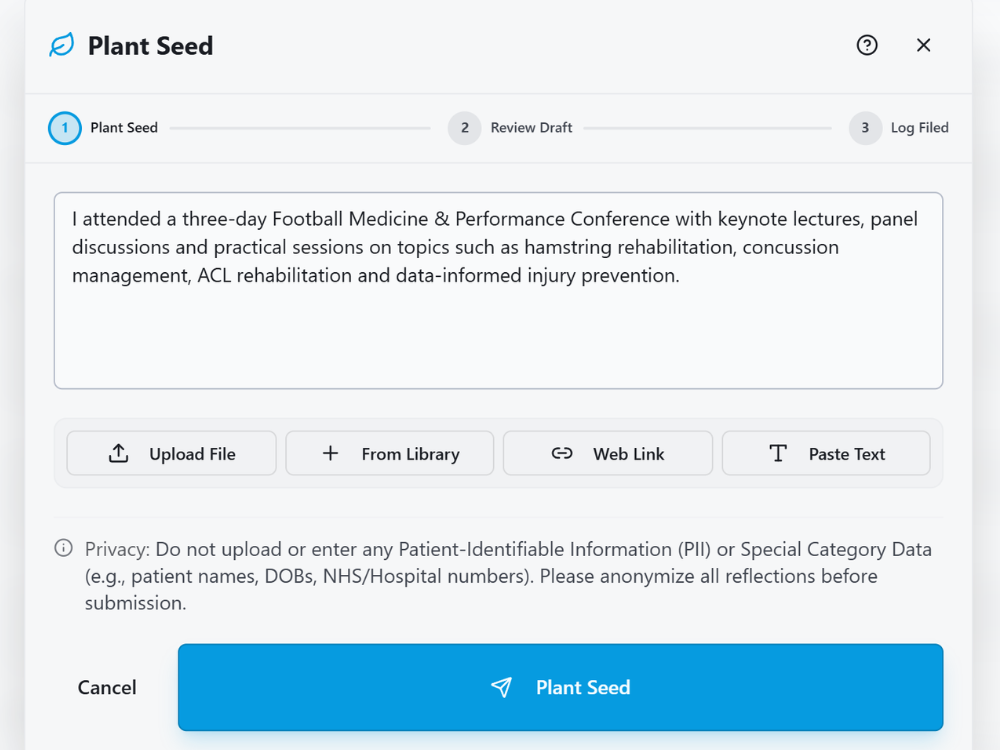
Step 1: Plant a Seed
Start with brief notes about the learning event, for example attending a three-day Football Medicine & Performance Conference covering hamstring rehabilitation, concussion management and return-to-play decision making. HandyCPD uses this seed to help structure a CPD log card you can review before going further.
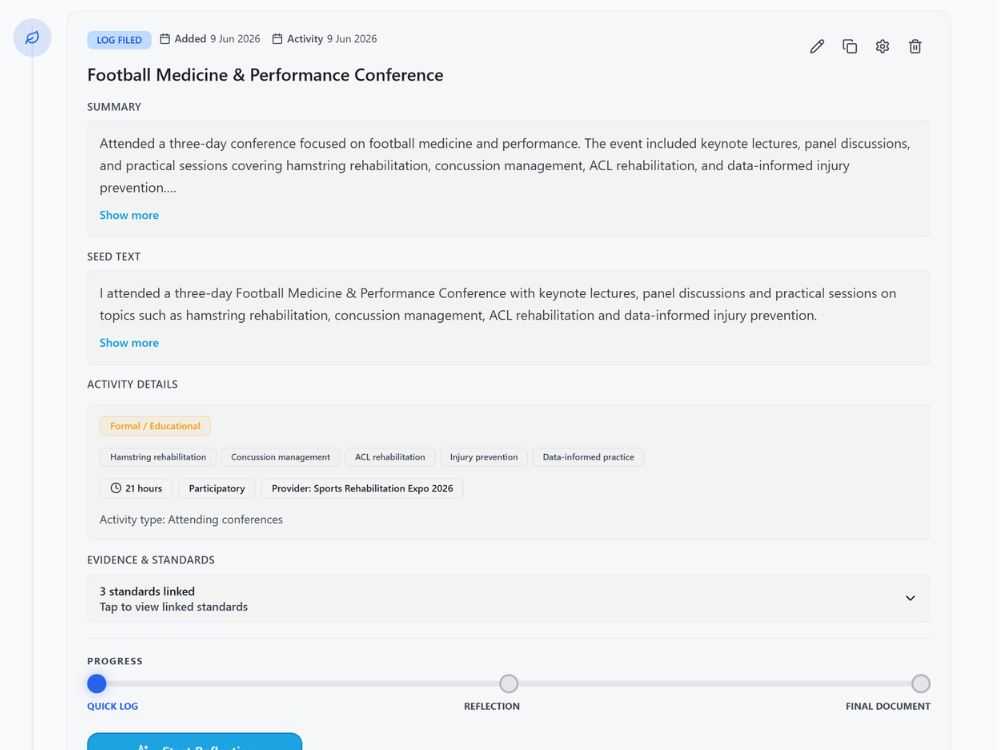
Step 2: Review your CPD log card
Check the structured summary, tags, duration and linked standards. Edit anything that is inaccurate or too identifying. Link supporting evidence while it is fresh. This is your record. AI suggestions are a starting point, not a finished CPD profile submission.
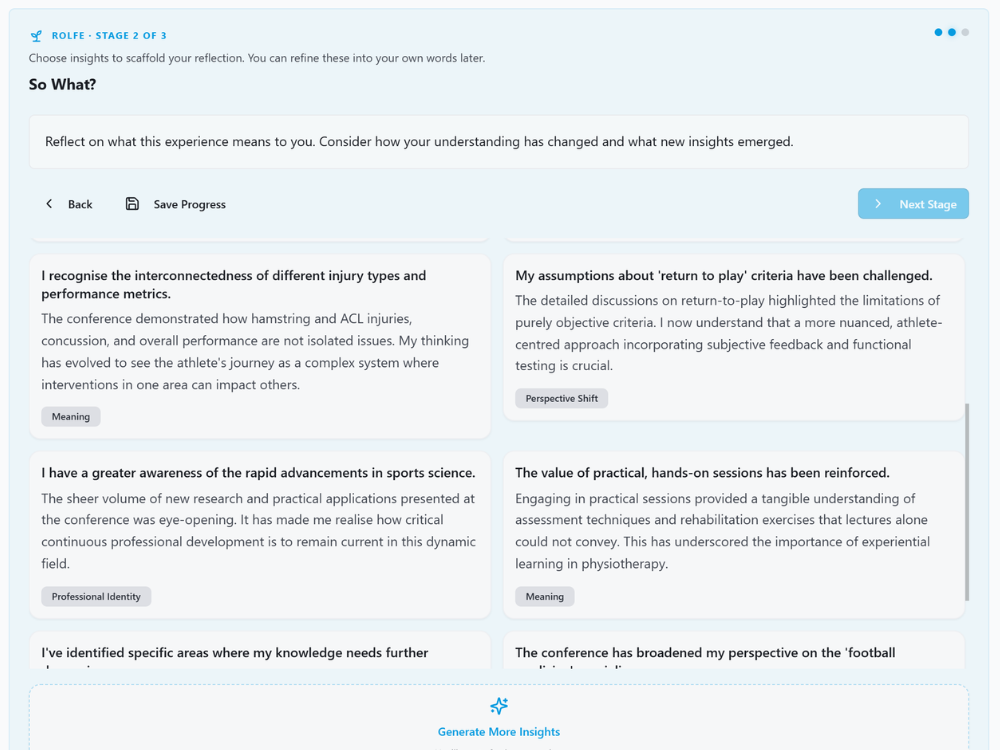
Step 3: Build your reflection
Use guided prompts and insight cards to scaffold what you learned, including impact on practice and people who use services. Select the points that reflect your own learning; refine them in your own words.
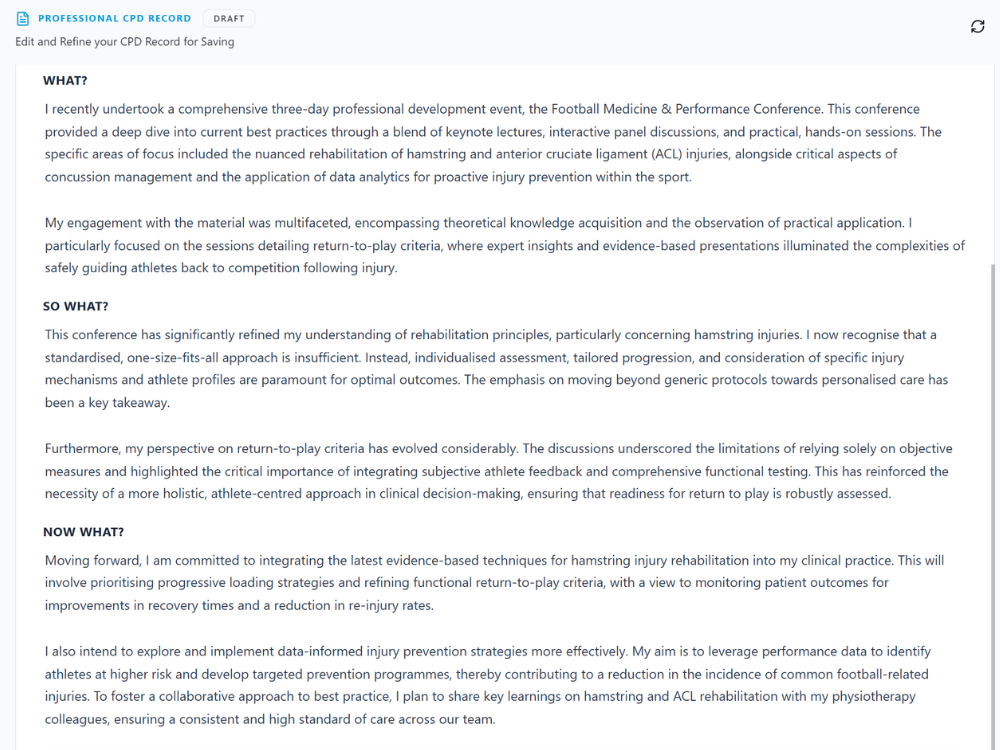
Step 4: Review your reflection draft
Read the full draft as if you were preparing a CPD profile for audit. Does it explain what you learned, how your thinking changed, and how it may benefit your practice and people who use services? Edit until it accurately represents your professional development.
Step 5: Create a PDF for your records
Export a PDF when you need a portable copy for your own portfolio or audit preparation. You choose what to include and must review exports before sharing or using them as supporting material. Check current HCPC guidance on what to submit in your CPD profile. HandyCPD supports your record-keeping; it does not submit on your behalf. PDF exports are explained on the CPD PDF Export feature page.
Important note about HCPC CPD and professional responsibility
Good HCPC CPD recording is grounded in honest reflection on learning and impact, not in polished prose that sounds impressive but misrepresents your practice. Whether you use HandyCPD, handwritten notes or another tool, you remain accountable for what you record and what you submit in a CPD profile if selected for audit.
Use anonymised examples. Avoid unnecessary identifiable or confidential information. If you use AI-assisted drafting, check that outputs are complete, accurate and appropriate before you rely on them. HandyCPD does not guarantee that any record format, wording or evidence will be accepted by HCPC, your employer or any other body.
Ready to organise HCPC CPD records you can review and approve?
Log CPD, attach evidence and build structured reflections with AI-supported drafts you edit before filing.
30-day Pro trial. No card required.