Reflection Engine
You may already have reflected. Writing it down is the hard part.
After a course, supervision, feedback, a difficult experience or an everyday workplace moment, many professionals have already done much of the thinking. The written CPD reflection is what gets postponed.
HandyCPD's Reflection Engine is an AI-assisted CPD reflection tool that helps worthwhile reflection make the journey from your head into a record you are confident keeping. It uses your learning, notes, evidence or experience as context, offers a scaffold and grounded ideas, and leaves the analysis, judgement and final wording with you.
You choose what fits, refine it in your own words, and approve every reflection before filing.
- Start from real learning instead of a blank page.
- Work through manageable stages and keep only what resonates.
- Review an editable draft based on your chosen thinking.
Why the written reflection gets left behind
The pattern is familiar, and it is rarely about not caring. Something worth reflecting on happens. You process much of it internally. Turning that internal work into writing can feel like repeating the thinking from the beginning. A blank page creates friction, so the reflection is postponed. A few notes may get saved and still feel unfinished. The learning never quite becomes part of your CPD record.
That sequence shows up after courses and conferences, supervision or peer discussion, feedback, quality improvement, emotionally significant experiences and everyday professional learning. It also appears when audit, revalidation, appraisal or renewal is approaching. Short notes can still be useful. Not every learning moment needs a long reflection. The difficulty is finishing a written record when the thinking already happened.
How the Reflection Engine works
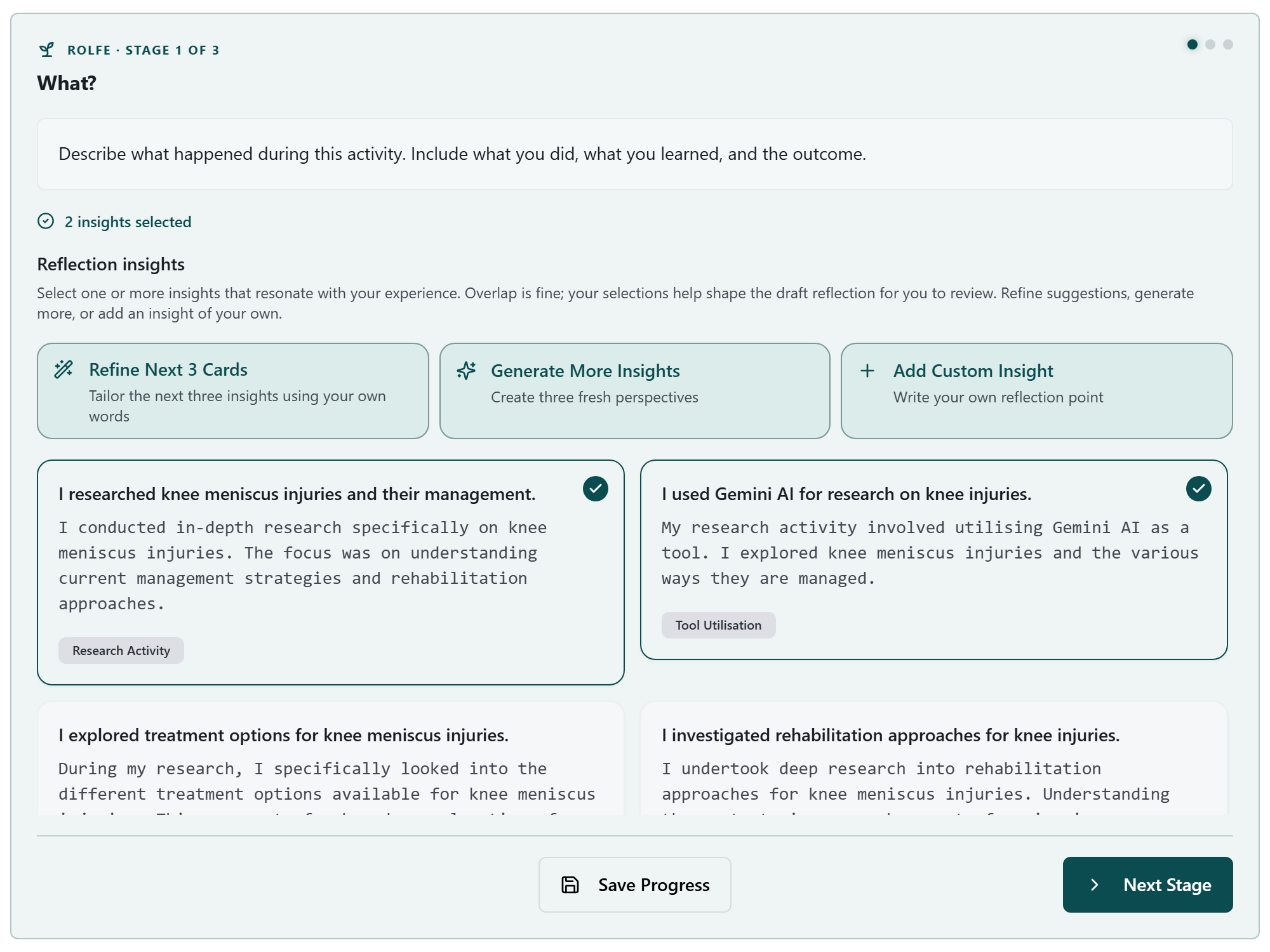
The Reflection Engine is a guided reflective workflow, not a blank document and not an instant reflection generator. Staged prompts and selectable insight cards help you recognise what mattered, develop ideas that fit your experience and shape an editable draft from the thinking you accepted.
The walkthrough below follows a Rolfe-style three-stage path. In the product, stage labels match the model you choose, such as What?, So what? and Now what?, or the longer Gibbs cycle. Other approaches, including NMC-focused support or Social Work England peer-reflection workflows, may be available depending on profession and regulator settings during onboarding.
For a step-by-step writing guide, see how to write a CPD reflection.
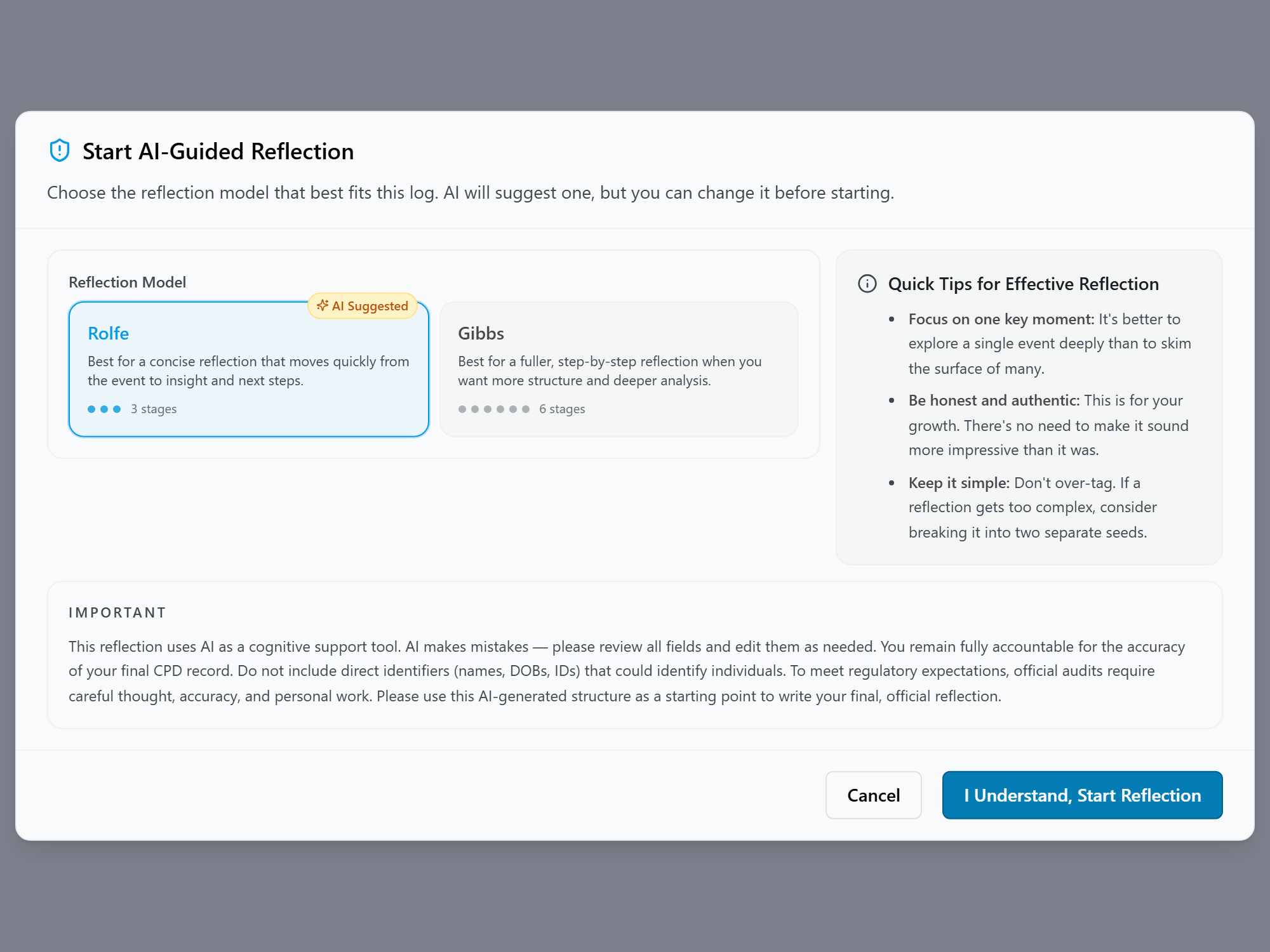
Step 1: Choose a reflection approach
You do not need to reconstruct a reflection model from memory. Choose an approach that fits the learning event. AI may suggest one based on your CPD log, but you can change it before you start. Rolfe is usually shorter and action-focused. Gibbs is usually longer and better suited to deeper or more complex experiences. Choosing a structure reduces uncertainty about how to begin.
Step 2: Explore what happened
The Reflection Engine can use your learning event, notes, evidence and available context to surface relevant possibilities. Responding to grounded ideas is often easier than generating and wording every thought from a blank page.
You actively evaluate the suggestions. Choose what fits, reject what does not and refine ideas in your own words. This is not passive submission of AI text.
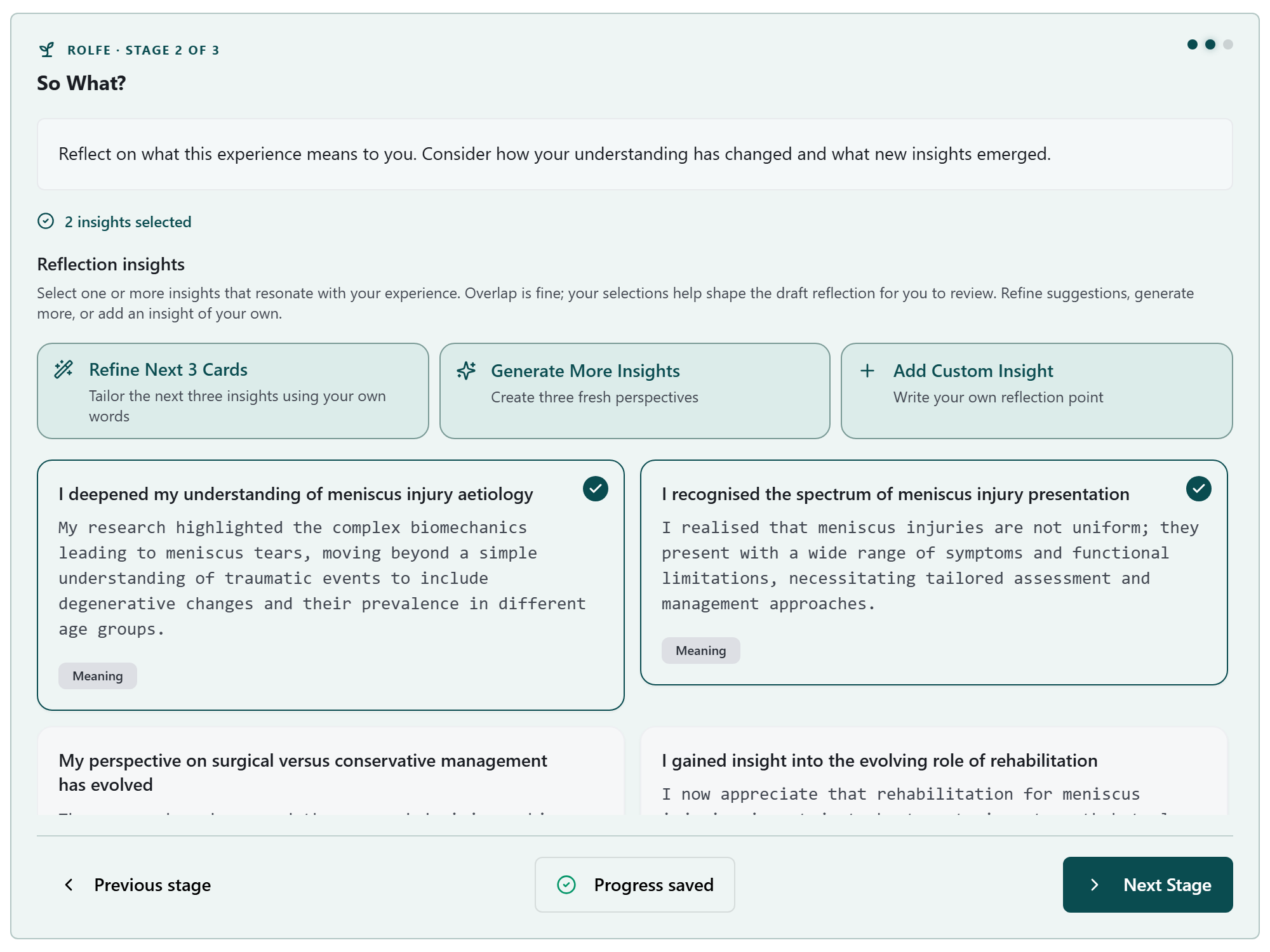
Step 3: Develop the learning
Description alone is rarely enough. Later stages help you move into meaning: what changed in your understanding, which assumptions shifted, what felt significant and how the experience connects to practice.
Selected insights from earlier stages help shape what comes next, so you are developing your own thread of thinking rather than starting again.
Step 4: Plan future action
This stage helps you consider what you may maintain, change, explore or apply next. It does not require a dramatic action plan for every reflection. Proportionate next steps are enough when that is what the learning calls for.
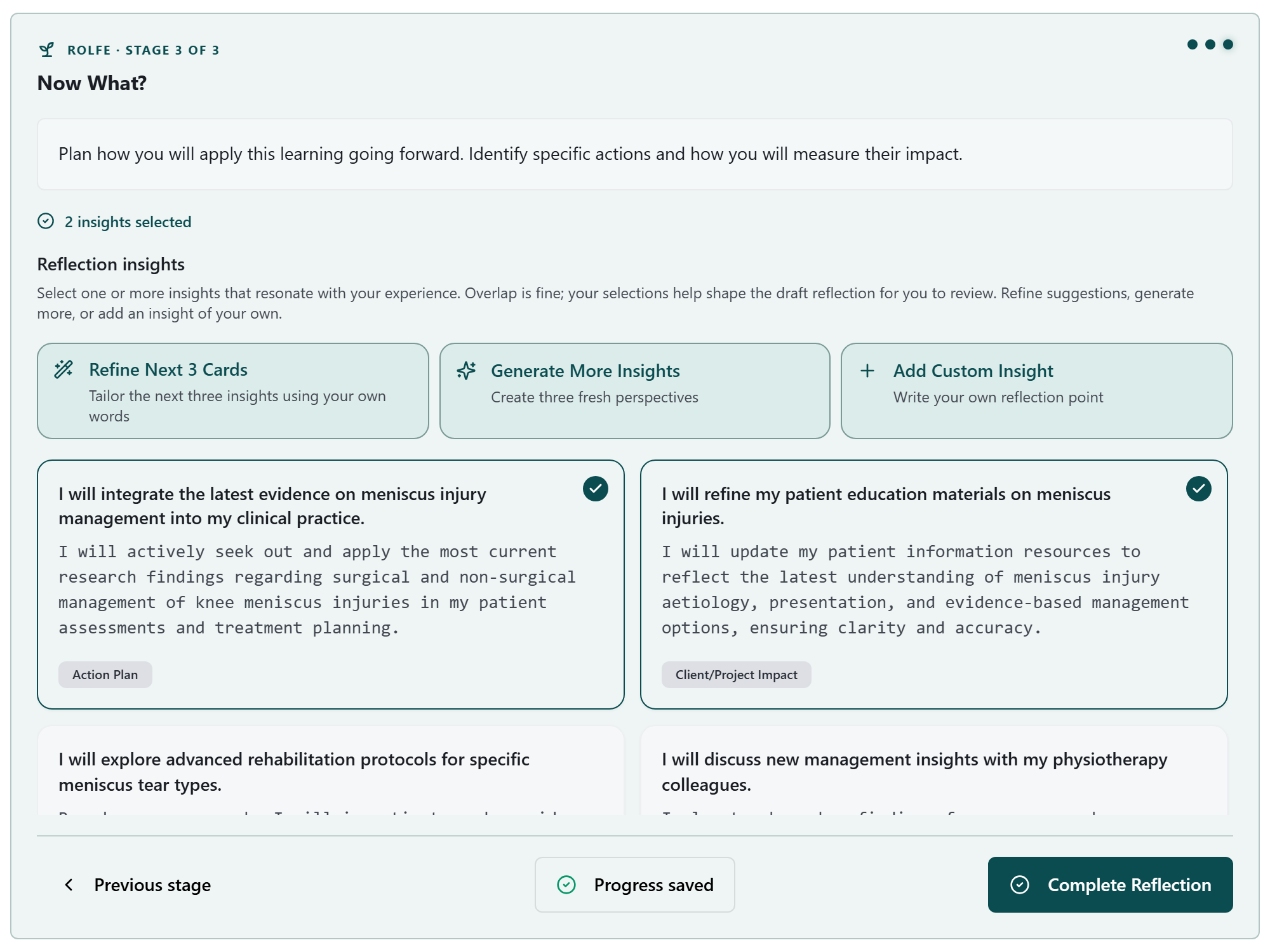
Step 5: Review and approve the draft
The structured draft is based on the thinking you selected and developed. You review, edit and approve it before filing. The AI-assisted draft is the result of the reflective process, not a replacement for it.
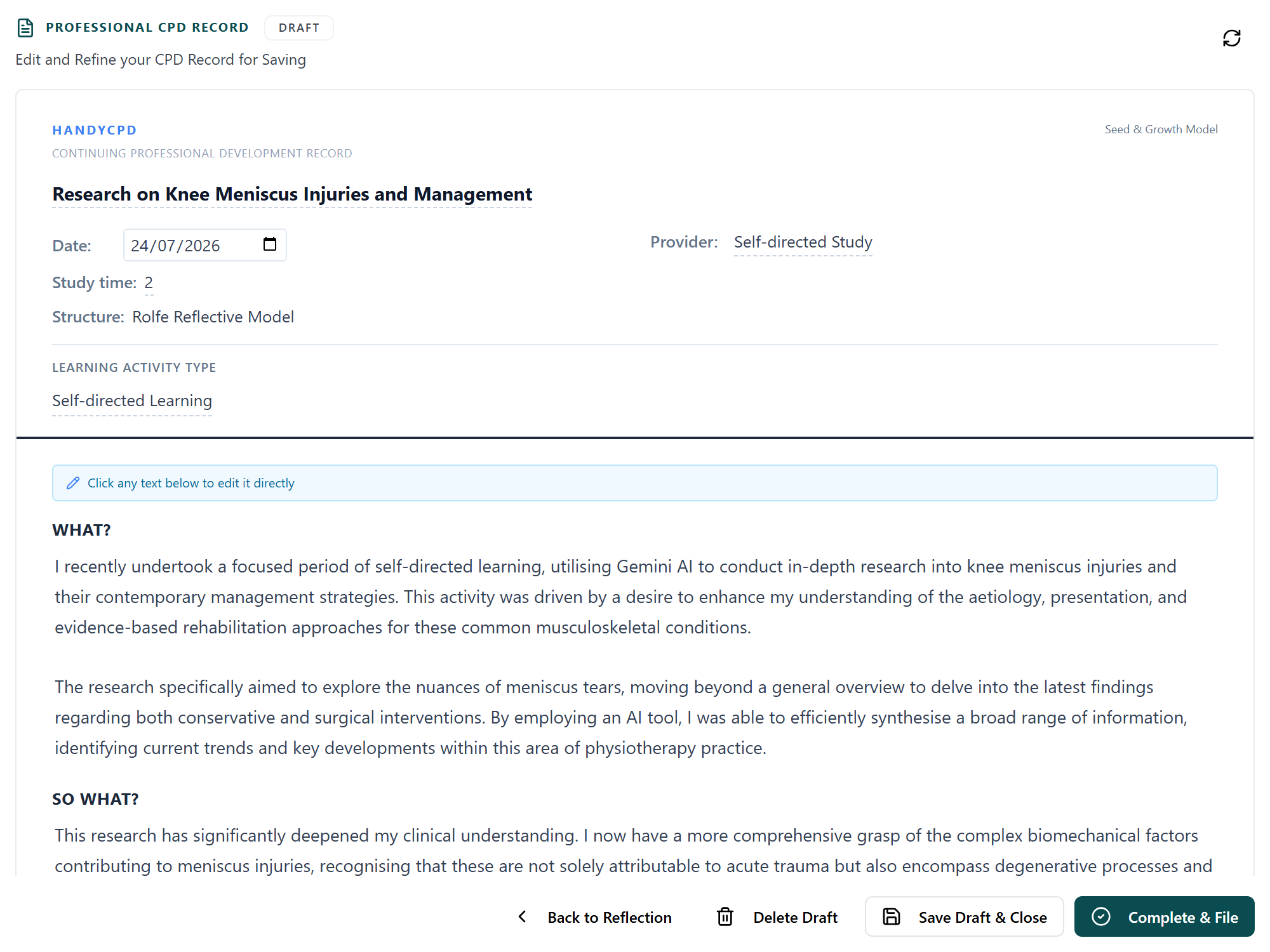
Who the Reflection Engine is for
It can help if you leave reflections until audit, revalidation or renewal time, struggle to start writing, know you learned something but find it hard to explain, or want a clearer route from experience to a record you trust. It works best when you start with real learning notes, evidence or context.
Reflection models for different situations
Rolfe: concise and practical
Rolfe's What? So what? Now what? structure is usually shorter and action-focused. It works well for concise reflections and practical learning where you want to move from the event to insight and next steps. See our Rolfe reflection model guide.
Gibbs: deeper and more exploratory
Gibbs is usually longer and better suited to deeper or more complex experiences, including emotionally significant or multi-layered learning. See our Gibbs reflective cycle guide.
Profession-specific reflection support
HandyCPD can adapt reflection support based on profession and regulator. HCPC registrants may find it useful to connect reflection with practice impact and CPD profile preparation. The HCPC reflective practice guidance explains why reflecting on practice matters for meeting standards.
NMC users may receive NMC-focused reflection support. For revalidation, nurses, midwives and nursing associates must prepare five written reflective accounts in each three-year period on the NMC's approved form. See the NMC written reflective accounts requirement and our NMC revalidation guide.
Social Work England users may use peer-reflection workflows. See our Social Work England CPD guide. These options support reflective practice. They do not imply regulator approval or guaranteed compliance.
A different kind of AI CPD tool
Some AI tools begin by producing finished wording from a request. The Reflection Engine begins with your real learning or experience and supports a guided reflective workflow. You evaluate ideas, keep what fits, reject what does not and develop your thinking. An editable draft follows that process. HandyCPD does not complete CPD or professional reflection on your behalf.
Common alternatives
- Leaving the reflection in your head.
- Postponing it until later, then later again.
- Saving only disconnected notes that never feel finished.
- Starting from a blank document with no scaffold.
- Trying to remember a reflection framework from training.
- Asking a generic AI tool to write something without a genuine reflective workflow.
Reflection Engine approach
- Start with the real learning or experience.
- Respond to grounded ideas and prompts.
- Decide what accurately reflects your thinking.
- Develop it through manageable stages.
- Receive an editable draft based on those choices.
- Remain responsible for review, accuracy and professional judgement.
Built for real-world professional learning
The Reflection Engine supports reflective learning from courses, conferences, supervision, peer discussion, feedback, difficult cases, quality improvement and everyday workplace learning. Some of the most valuable CPD happens during ordinary professional practice, not only formal courses.
AI supports reflection, not professional judgement
AI can suggest wording, structure, prompts and possible lines of exploration. Suggestions may be incomplete, inaccurate or inappropriate. You decide what resonates. You remain responsible for factual accuracy, confidentiality and professional judgement. Review and edit every draft before treating it as part of a CPD record.
Avoid entering identifiable, confidential or special-category information unless you have an appropriate lawful basis and understand the risks. HandyCPD does not guarantee regulator, employer, auditor or appraiser acceptance.
See the Reflection Engine in practice
These example pages walk through realistic CPD journeys. They show how a learning activity can be recorded and developed into a reflection with the Reflection Engine. The scenarios are illustrative examples, not regulator-endorsed case studies or accounts of identifiable people.
Example page
Occupational therapy CPD examples
Follow fictional OT learning journeys from a recorded activity through guided Reflection Engine stages into a reviewed draft.
View occupational therapy CPD examplesExample page
Physiotherapy CPD examples
See how example physiotherapy CPD records use the Reflection Engine to develop learning into structured reflections for review.
View physiotherapy CPD examplesReady to turn reflection into a record you keep?
Begin without a blank page, develop your thinking in manageable stages and approve a reflection worth keeping.
30-day Pro trial. No card required.