
CPD RESOURCE
Social Work England CPD recording: using AI safely to structure peer reflections
This guide is for registered social workers in England who need clearer Social Work England CPD records, including peer reflection, supporting CPD evidence and anonymised CPD examples. It explains how social work CPD recording can move from rough notes to structured reflections with safe AI for CPD support, while you stay responsible for checking, editing and approving every record.
HandyCPD can support different types of CPD reflection by letting you choose the reflection approach that fits each activity, from standard individual reflective practice after training or supervision, to a peer-reflection style workflow when your learning came from discussing CPD with another professional.
Resources support CPD learning and organisation. You review and approve every record.
This page focuses on Social Work England registrants in England. Social workers in Wales, Scotland and Northern Ireland should check their own regulator's requirements. Always verify current Social Work England guidance yourself before submitting CPD for CPD renewal.
Why Social Work England CPD can feel difficult to record
Many social workers do meaningful CPD every week: supervision, case discussions, training, reading and practice learning. Many struggle to turn that into records that show what changed. Social Work England CPD is not a box-ticking exercise: it should explain learning and impact, not just list an activity title.
Common CPD recording problems
- Writing only what happened, without what you learned or how your thinking changed.
- Leaving peer discussions undocumented, even when they shaped your practice.
- Including unnecessary service-user-identifiable or confidential detail in notes or drafts.
- Scrambling to reconstruct records near the renewal deadline instead of recording as you go.
- Treating AI-generated text as finished, without careful review and editing.
What a clearer CPD record can show
- What you learned from the activity and why it mattered to your role.
- How your thinking or approach changed as a result.
- The impact on your future practice and on people who use services.
- Where peer reflection added perspective you would not have captured alone.
- Enough anonymised context that the record still makes sense months later.
What Social Work England expects from CPD reflection
Current Social Work England guidance states that registered social workers must record CPD that supports safe, effective practice. Registrants must record a minimum of 2 different pieces of CPD, record each piece separately in the Social Work England online account, and complete requirements by midnight on 30 November each year as part of registration renewal.
Not every CPD record is necessarily a peer reflection. You may have one or more ordinary reflective CPD entries alongside a peer-reflection entry. Current guidance states that at least one piece of CPD must include peer reflection. HandyCPD can help you structure different types of CPD reflection, from general reflective practice notes to peer-reflection records, by choosing the reflection approach that fits each activity.
Strong records go beyond describing an activity. They explain what you learned, how your thinking changed, what you will do differently, and how that may benefit people who use services, aligned with how Social Work England describes good CPD in its examples and guidance.
HandyCPD can help you organise supporting CPD evidence and notes for your own record-keeping and reflection workflow. Always check what Social Work England currently asks registrants to record or upload in its own online account. This guide does not imply that Social Work England requires certificates or evidence uploads for every CPD entry.
Why peer reflection matters
Peer reflection is a specific type of reflective CPD. It is where you record what you learned from discussing a CPD activity with a peer, manager or other relevant professional, not simply describing the activity on its own.
Current Social Work England guidance treats peer reflection as distinct because discussion can surface alternative perspectives, challenge assumptions and strengthen professional judgement. That learning is easy to lose if you only note that a conversation happened. For more on writing reflective entries generally, see our CPD reflection guide.
How AI can help without replacing your judgement
AI can help structure rough notes, suggest prompts and draft reflection sections for you to review. It should not invent CPD activities, supervision sessions or evidence you did not do. Treat every AI-assisted output as a draft: edit for accuracy, tone and professional context before treating it as part of your CPD record.
Do not include service-user-identifiable, confidential or special-category data in AI tools or in examples you store in HandyCPD. Keep reflections anonymised and focused on learning, actions and outcomes.
Inside HandyCPD, users can choose the reflection approach that best fits the CPD record they are creating. For Social Work England users, this may include a peer-reflection style workflow for CPD discussed with another professional, or a more general reflective practice workflow for other learning activities. The Reflection Engine guides you through staged prompts. You remain responsible for every word you save.
Example: from peer review discussion to structured CPD reflection in HandyCPD
The steps below walk through a peer reflection example: a manager peer review on adult safeguarding and self-neglect. That is the Social Work England requirement many social workers find hardest to record. When you are creating a different kind of CPD reflection, you can choose another reflection approach in HandyCPD.
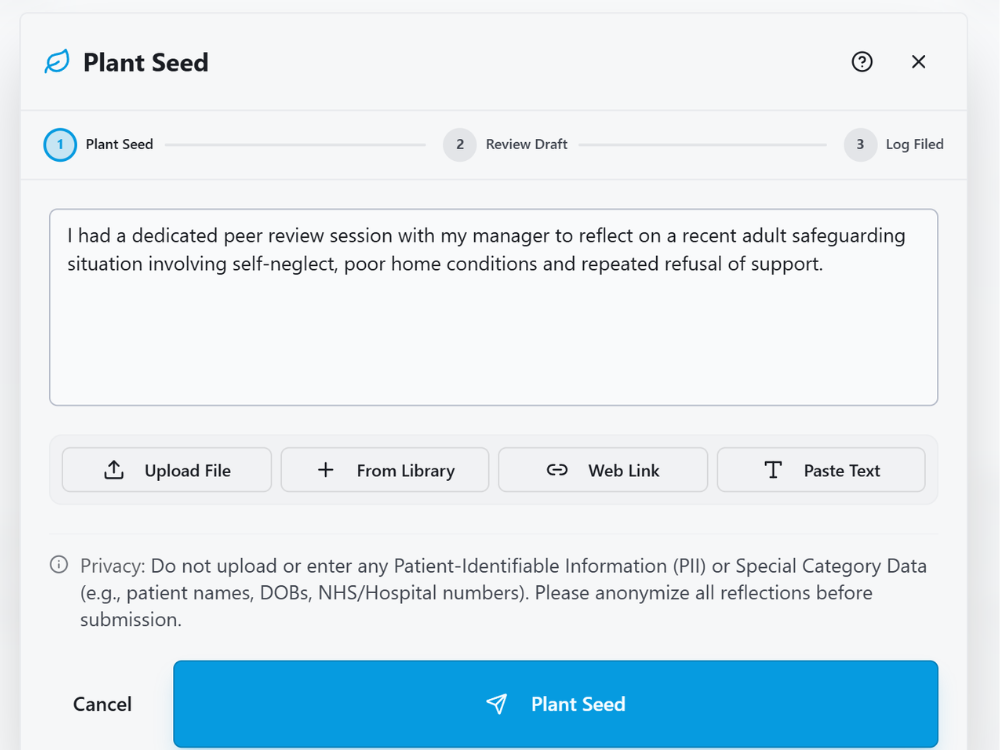
Step 1: Plant a Seed
Start with brief, anonymised notes about the learning event, for example a peer review with your manager on a safeguarding theme. HandyCPD uses this seed to help structure a CPD log card you can review before going further.
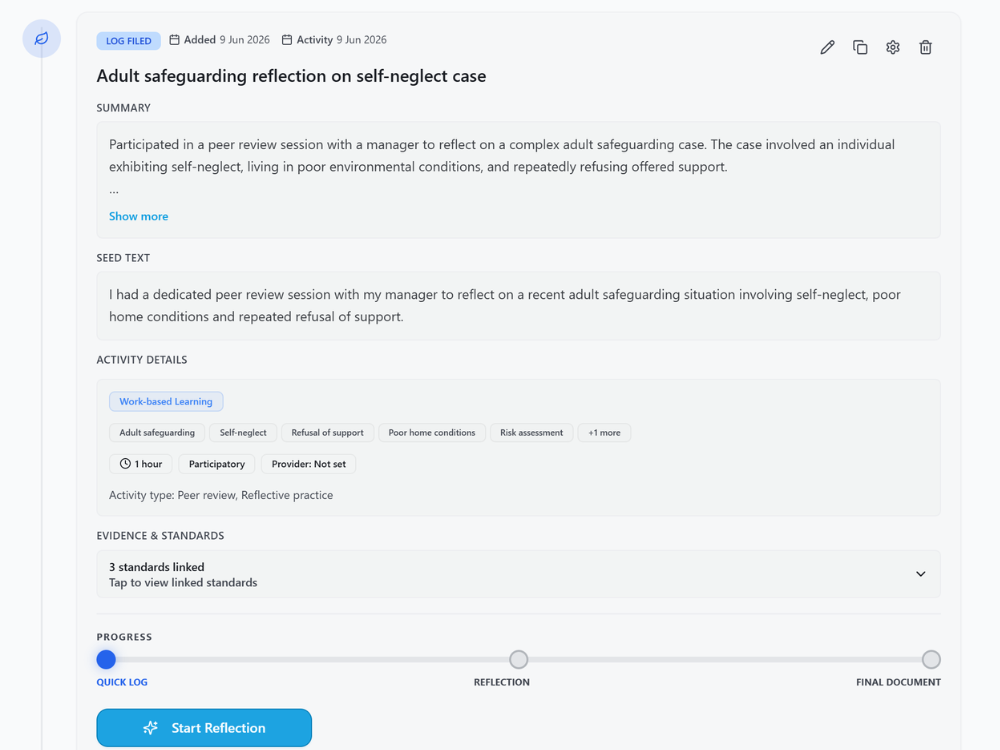
Step 2: Review your CPD log card
Check the structured summary, tags, duration and linked standards. Edit anything that is inaccurate or too identifying. This is your record. AI suggestions are a starting point, not a finished Social Work England submission.
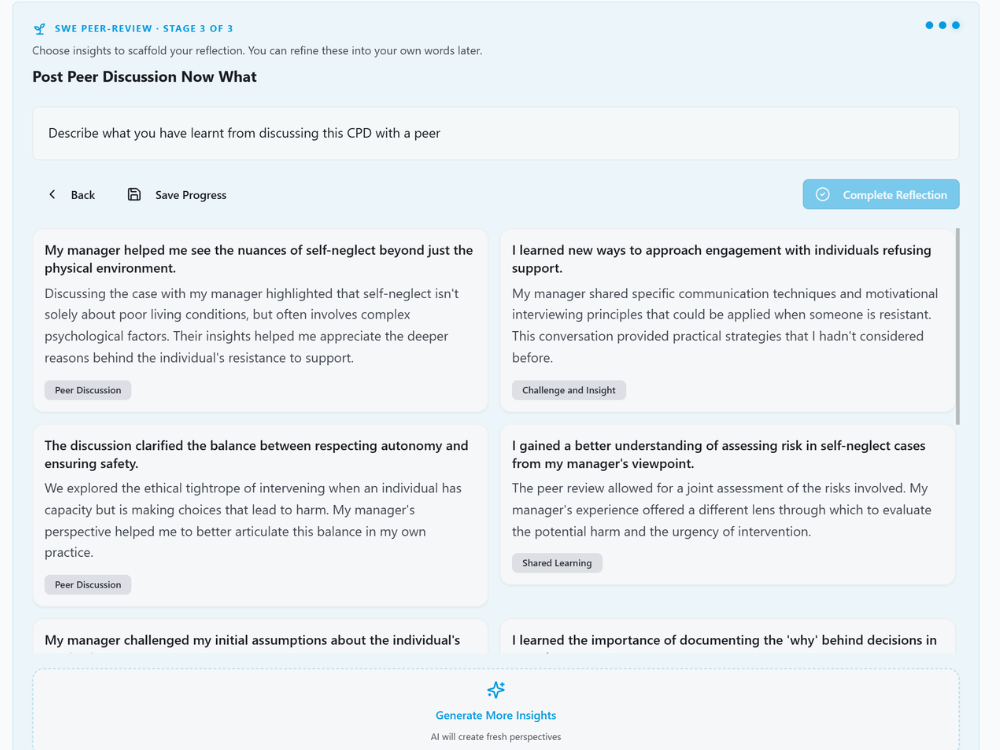
Step 3: Build your peer reflection
Use guided prompts and insight cards to scaffold what you learned from the peer discussion, including impact on practice and people who use services. Select the points that reflect your own learning; refine them in your own words.
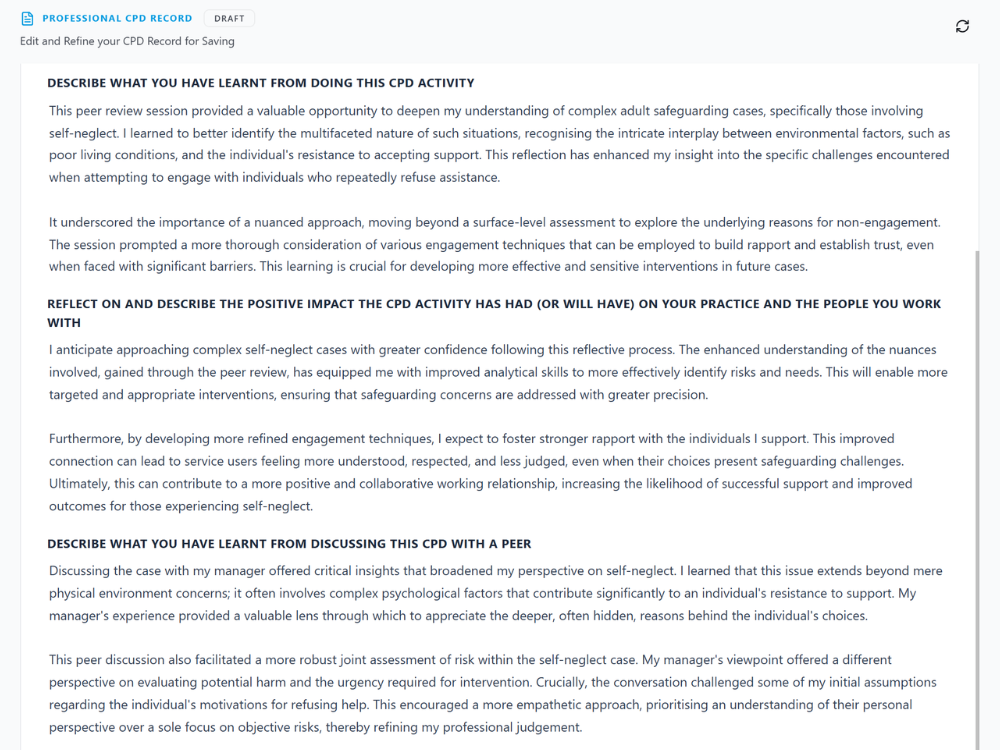
Step 4: Review your reflection draft
Read the full draft as if you were reviewing it at renewal. Does it explain what you learned, how your thinking changed, and what you learned specifically from discussing the CPD with another professional? Edit until it accurately represents your practice.
Step 5: Create a PDF for your records
Export a PDF when you need a portable copy for your own portfolio or appraisal. You choose what to include and review exports before sharing. Remember to transfer the final wording Social Work England requires into your Social Work England online account separately. HandyCPD supports your record-keeping; it does not submit CPD on your behalf.
Important note about social work CPD and professional responsibility
Good social work CPD recording is grounded in honest reflection on learning and impact, not in polished prose that sounds impressive but misrepresents your practice. Whether you use HandyCPD, handwritten notes or another tool, you remain accountable for what you record and what you tell Social Work England at renewal.
Use anonymised examples. Avoid unnecessary identifiable or confidential information. If you use AI-assisted drafting, check that outputs are complete, accurate and appropriate before you rely on them. HandyCPD does not guarantee that any record format or wording will be accepted by Social Work England, your employer or any other body.
Ready to support clearer Social Work England CPD records?
Capture peer reflection learning, organise evidence and review reflection drafts before you rely on them.
30-day Pro trial. No card required.