CPD RESOURCE
How to write a CPD reflection
A useful CPD reflection does more than record that something happened. It explores what an experience or piece of learning meant, how it affected your understanding, and what follows for your professional practice. This guide is for anyone who wants to reflect on learning or reflect on an experience more thoughtfully, whether the starting point was a course, supervision, feedback, a difficult situation or an ordinary day at work.
You can use these ideas with any note-taking tool or portfolio system. The aim is to strengthen how you reflect and how you write that thinking up as a professional record.
What reflection really is
Reflective practice involves examining experiences and learning more deliberately, rather than simply recording what happened. It helps you learn from experience by asking what stood out, why it mattered, and how it connects to the way you work. Strong reflection can reveal changes in understanding, assumptions and professional judgement, including where something remains uncertain or unfinished.
Valuable learning often comes from day-to-day practice, not only formal education. Supervision, peer discussion, feedback, challenging situations, quality improvement work and everyday professional decisions can all generate meaningful development if you take time to explore them.
Reflection is valuable for professional growth in its own right. It can also support portfolios, appraisals, audits or revalidation, but it is not useful only for those purposes. At its best, it strengthens decision-making, highlights learning needs and improves how you approach similar situations in future, including where that may affect people who use services.
Reflection may already be happening
Reflection does not always begin at the moment you open a document. After an experience, and sometimes during it, you may already have replayed what happened, wondered whether you handled something well, noticed an emotional reaction, questioned a decision, recognised discomfort or uncertainty, talked it through with someone, or realised that an assumption had been challenged. Those emerging thoughts are already part of reflective practice.
Deliberate reflection gives you a chance to explore those thoughts more deeply: what actually stood out, why it affected you, what you assumed beforehand, whether those assumptions still hold, what remains uncertain, whether another perspective changes the picture, what you learned about your judgement, what this means for practice, and what you might do or learn next.
Writing is part of that relationship too. Putting thoughts into words is not only transcription after reflection has finished. Articulating an experience can itself deepen reflection. You may notice a connection you had not recognised, an assumption you had not questioned, uncertainty you had glossed over, or an implication for practice you had not yet formulated. Informal reflection, deliberate exploration and writing often move back and forth, until you can shape a coherent professional record. That is an explanation of how reflection can develop, not another model you are expected to follow.
Moving beyond "what happened?"
Many CPD entries stop at description: what you attended, what was said, what you did. Description has a place. You need enough context to make the learning understandable later, but reflection asks what the experience meant.
Start from whatever is already in mind. If something stayed with you, ask why. What surprised or challenged you? What had you assumed beforehand, and has anything changed in how you understand the situation? Naming a shift in understanding, even a small one, often marks the move from recounting to reflecting.
Deeper or critical reflection can involve questioning assumptions, considering other perspectives, examining uncertainty, and exploring why an experience affected your thinking. Not every CPD reflection needs that depth, but when the learning warrants it, those questions help you go further than a descriptive account.
It also helps to leave room for what is incomplete. What remains uncertain? Is there another perspective you had not considered, such as a colleague's view, a service user's experience, or a constraint you underweighted at the time? Honest reflection includes difficulty and unfinished learning, not only polished success.
Then connect meaning to practice. Why does this matter to your professional judgement or the way you work? Where relevant, could it affect people you work with or people who use services, through clearer communication, safer decisions, or a more thoughtful approach? What do you still need to understand, and what might you do differently next time? Specific, realistic next steps are usually more useful than a vague intention to “improve.”
You do not need to march through every question in a fixed order. Use the ones that genuinely open up the experience. The point is to take an emerging thought further, from what happened toward meaning, implications and learning, rather than completing a checklist.
A CPD reflection example: moving beyond description
The same learning event can produce a thin descriptive note or a more useful reflection. Compare the two versions below. Both are fictional and anonymised. They are for teaching, not for copying into your own records.
A descriptive starting point
“I attended a session on communicating uncertainty when plans change and learned some useful tips about keeping people informed.”
That records attendance and a general takeaway. It does not yet show what changed in the person's understanding, or what they will do differently.
A deeper reflection on the same event
What stood out: a short session on communicating uncertainty when priorities or timelines change.
What it raised for me: I noticed I sometimes reassure people quickly when I do not yet have a clear answer, partly to reduce my own discomfort with uncertainty, not only to be helpful.
What shifted: I had treated “keeping people updated” as enough. I now see that overconfident reassurance is not the same as communicating uncertainty well, and it can undermine trust if plans later change.
For my practice: in similar situations I will be clearer about what is known, what remains unknown, what happens next, and when I will give another update, rather than filling the gap with optimistic guesses.
Next: I will watch for moments when I over-reassure, take this to supervision, and follow up with further reading on communicating uncertainty.
The second version is stronger because it explores meaning, self-questioning and consequences, not because it is longer. Depth comes from what changed in understanding and what follows for judgement and practice.
Keep your own examples anonymised. Do not include identifiable details about patients, clients, service users or colleagues. For longer fictional walkthroughs by profession, see our physiotherapy CPD examples and occupational therapy CPD examples.
Writing up your reflection
Writing captures reflective thinking that may already be forming, and it can also deepen that thinking. As you try to explain an experience in words, you may organise ideas, make learning explicit, notice new connections, and create a record you can return to later. The written CPD reflection is not a bureaucratic form to complete after all insight has finished. It is part of how reflection becomes usable professional learning.
Aim to explain the learning rather than only the event. Include enough anonymised context that the entry still makes sense months later, and focus on what changed or became clearer. Be honest about difficulty, uncertainty or incomplete learning. Avoid manufacturing an impressive outcome when the real insight is unresolved. Where you identify future actions, make them specific and proportionate. Longer writing is not automatically more reflective.
Common mistakes that weaken CPD reflections
Only describing what happened. A list of events is not a reflection. Add what you learned, why it mattered and how your thinking changed. After describing the activity, ask what it meant.
Forgetting the learning. Name the learning explicitly: new knowledge, a changed assumption, a skill you developed or a professional boundary you reconsidered. Without this, the entry reads like a diary note.
Missing impact on practice. Connect the learning to how you work. What will you do differently in similar situations? How does this affect your judgement, communication or professional standards?
Not identifying future actions. Reflection should often point forward. Include realistic next steps, such as further reading, supervision themes, practice changes or follow-up learning, rather than ending at “I found this useful.”
Treating AI-generated text as final. AI-assisted drafts can help organise thoughts, but they are starting points, not finished reflections. Check accuracy, tone and professional context. Remove anything that misrepresents your experience or includes detail you should not record.
When a reflective model helps and when it does not
Reflective practice does not begin when someone selects Gibbs, Rolfe or another framework. A reflective model is a scaffold for exploring thinking, not reflection itself. Models can help you examine an experience more systematically; they do not create reflective thought on your behalf.
Structure can be particularly useful for a complex or significant experience, something emotionally challenging, a situation with several perspectives, or when you are unsure where to start. Shorter or more straightforward learning may not need a formal model. A simple account of what you learned, why it mattered for practice and what you will do next can be enough.
Regulators do not typically mandate one specific reflective framework. Choose an approach that helps you think clearly about the learning at hand, and check current guidance from your own regulator when you need official requirements.
Gibbs and Rolfe as optional scaffolds
Gibbs' reflective cycle moves through description, feelings, evaluation, analysis, conclusion and action planning. It suits deeper exploration of significant learning. See our Gibbs reflective cycle guide for a full walkthrough.
Rolfe uses three questions (What? So what? Now what?) for concise, purposeful reflection. It suits shorter entries where you want structure without length. See our Rolfe reflection model guide.
For regulator-specific CPD context, you may also find our HCPC CPD guide, Social Work England CPD guide and NMC revalidation guide useful. These guides support record-keeping; they do not imply regulator endorsement of HandyCPD.
Turning reflection into a useful CPD record
A useful CPD record should let a later reader, including your future self, understand what the relevant learning or experience was, what you took from it, why it mattered, what changed in your understanding or practice, what remains to be explored, and what you intend to do next. It does not need to turn reflection into bureaucracy.
Recording learning reasonably close to the event often helps. Details and insights fade; a short anonymised note made while the experience is fresh can preserve enough for a fuller reflection later. Keep reflections linked to the activities and evidence they relate to where that helps you stay organised, for example through structured CPD logging, but the quality of the reflection still depends on your thinking and judgement, not on the filing system alone.
How HandyCPD can support your reflection
You may already have reflected internally, and even developed useful insights, yet still find it difficult to articulate those thoughts, explore them further, decide where to begin, organise them, or turn them into something coherent enough to keep as a professional CPD record.
HandyCPD's Reflection Engine can support that part of the work. It starts from your own learning or experience notes, helps you choose an appropriate reflective approach, and provides a scaffold rather than an empty document. Prompts and relevant ideas can help you explore and get emerging thoughts into written form. You decide what is relevant, refine ideas in your own words, and review an organised draft before anything becomes part of your record. Professional judgement stays with you: HandyCPD supports reflection; it does not generate a finished reflection on your behalf.
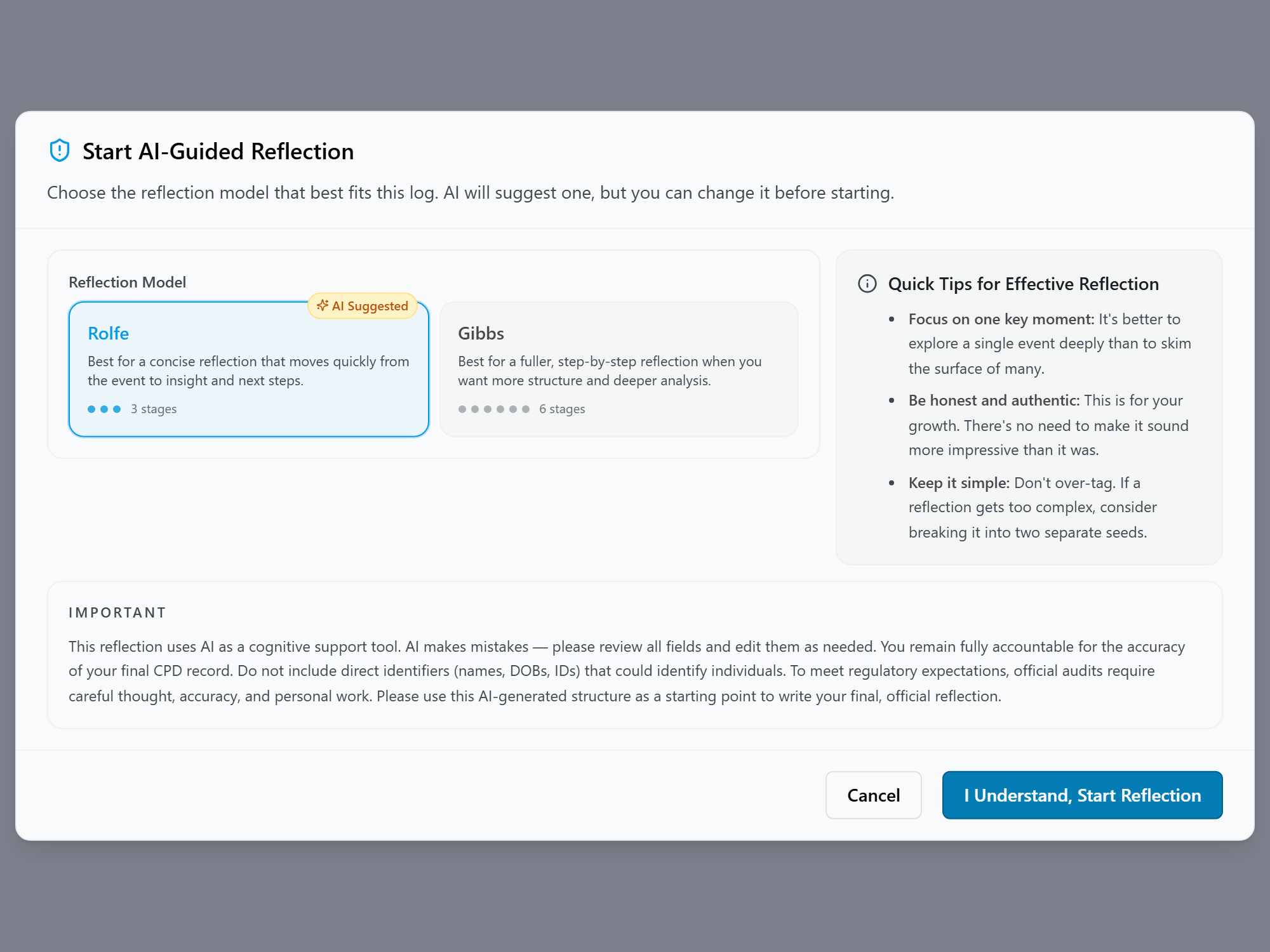
Choose a reflective approach that fits
When a scaffold would help, you can choose an approach suited to the learning, for example a shorter Rolfe-style path or a deeper Gibbs cycle, without needing to reconstruct a model from memory. The model remains optional support for thinking, not a requirement that creates reflection by itself.
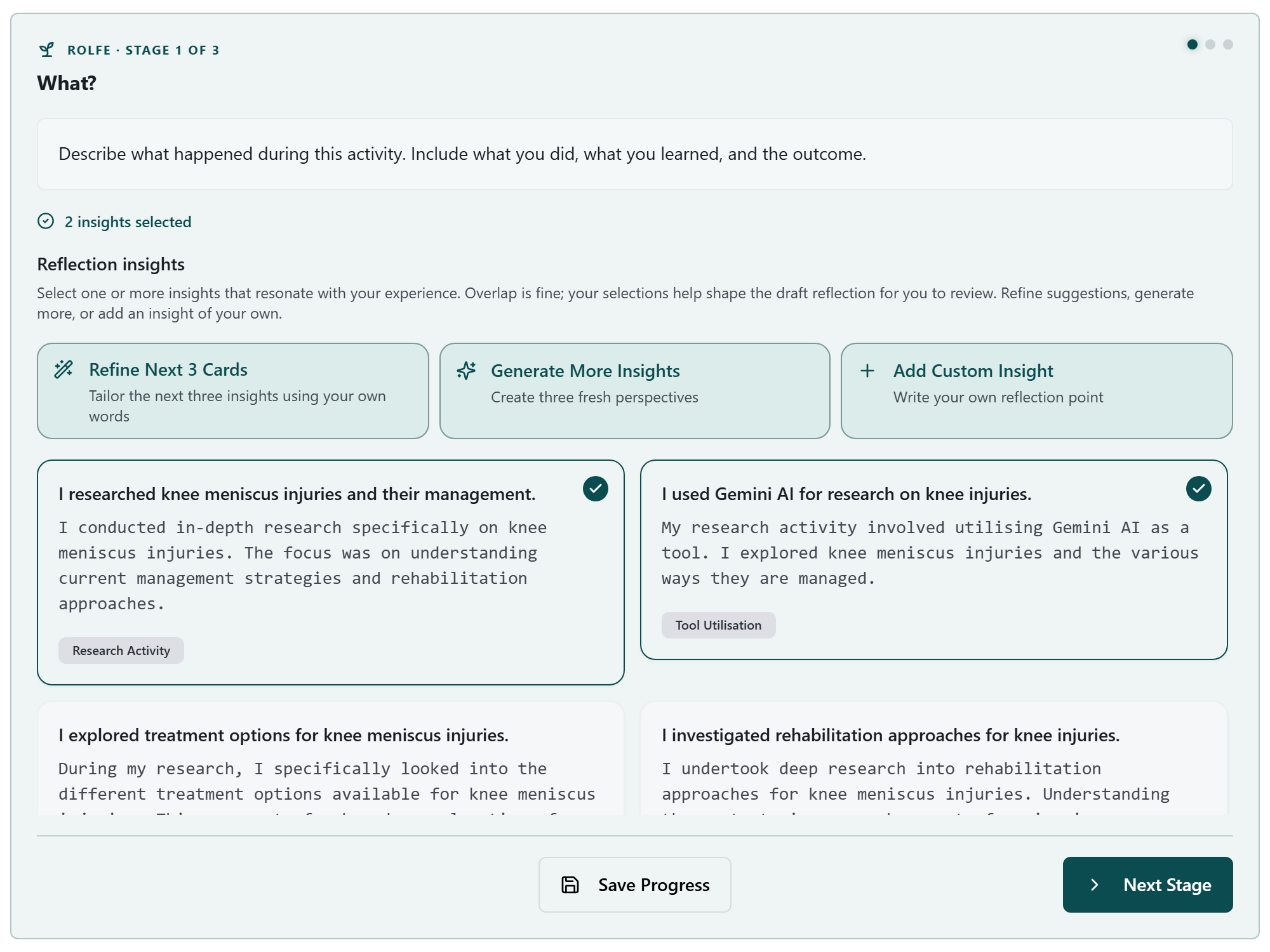
Explore your thinking from your own notes
Rather than facing a blank page, you can respond to prompts and ideas grounded in your notes and context. Keep what fits your experience, reject what does not, and refine wording so the reflection stays yours.
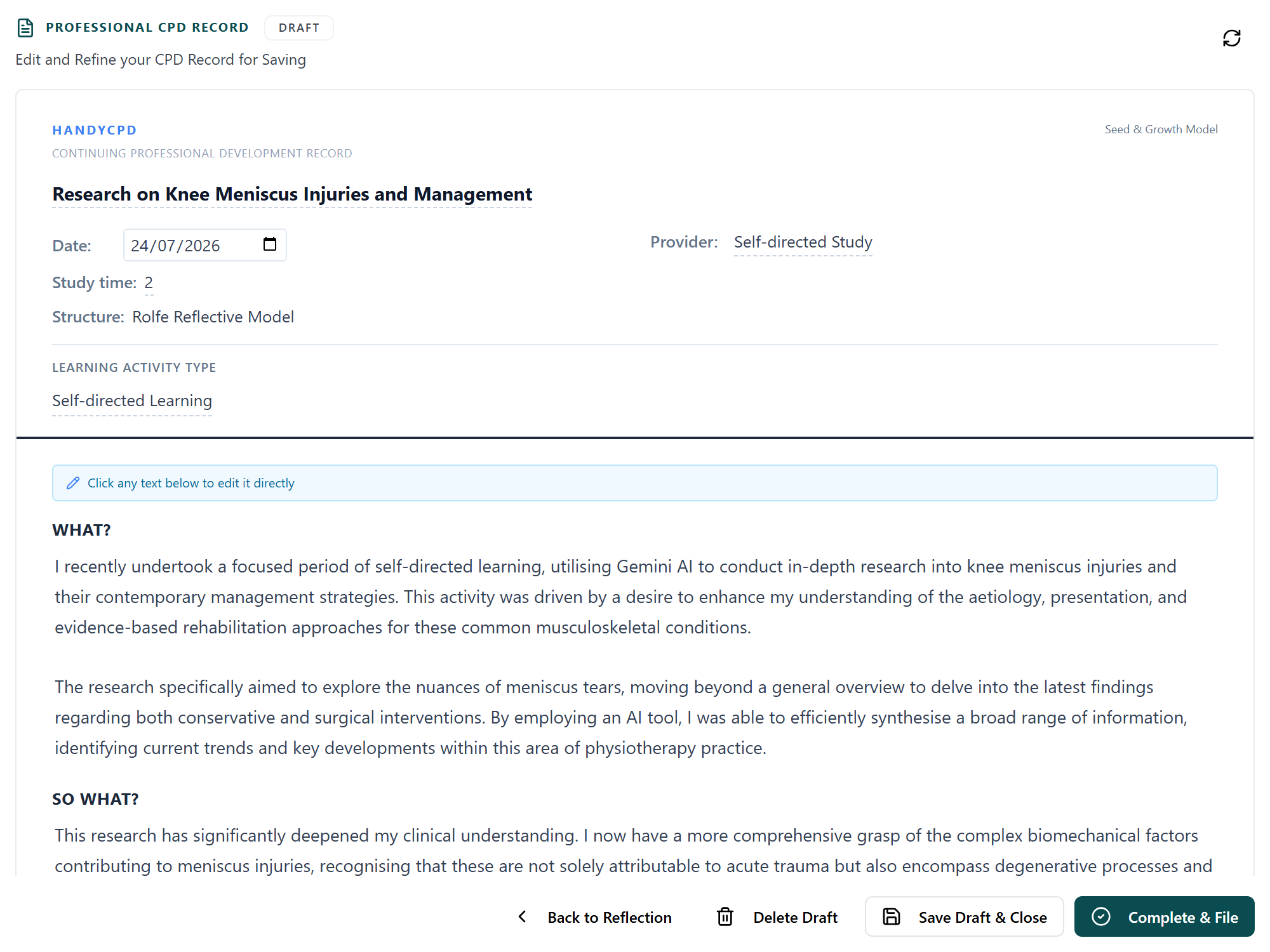
Review a draft you own
Selected thinking can be organised into a coherent draft for you to edit and approve. Treat every draft as something you must check for accuracy, relevance, confidentiality and professional appropriateness before filing it.
Keeping reflection safe and professionally sound
CPD content can be sensitive. Protect confidentiality whether you write by hand, in a portfolio tool or with AI-assisted drafting.
- Anonymise: remove names, identifiers and details that could identify individuals.
- Respect confidentiality: do not paste confidential workplace, client or service-user information into AI tools or records unnecessarily.
- Avoid special-category data: unless you have a lawful basis and understand the risks, do not include health, ethnicity or other special-category information in drafts or examples.
- Review AI outputs: edit for accuracy, completeness and appropriateness before treating any draft as part of your CPD record.
- Keep professional judgement: you decide what is accurate, relevant and appropriate for your practice and professional context.
Ready to organise reflections you have already begun thinking through?
Start from your own learning notes, choose a reflective approach when it helps, and keep only the draft you review and approve.
30-day Pro trial. No card required.