
CPD RESOURCE
Occupational therapy CPD examples: hand therapy, community and mental health
This page walks through three fictional occupational therapy CPD examples from hand therapy, community practice and mental health settings. Each example outlines possible reflection themes, how the learning could influence practice, and how the activity could be recorded and developed in HandyCPD.
The examples are fictional. Do not copy them into your own portfolio or professional submission. Adapt the structure to your role, scope and learning. UK occupational therapists must meet HCPC CPD requirements; for general expectations, see our HCPC CPD guide. HandyCPD supports structure and reflection drafting; you remain responsible for reviewing, editing and approving every record.
Resources support CPD learning and organisation. You review and approve every record.
How to use these examples
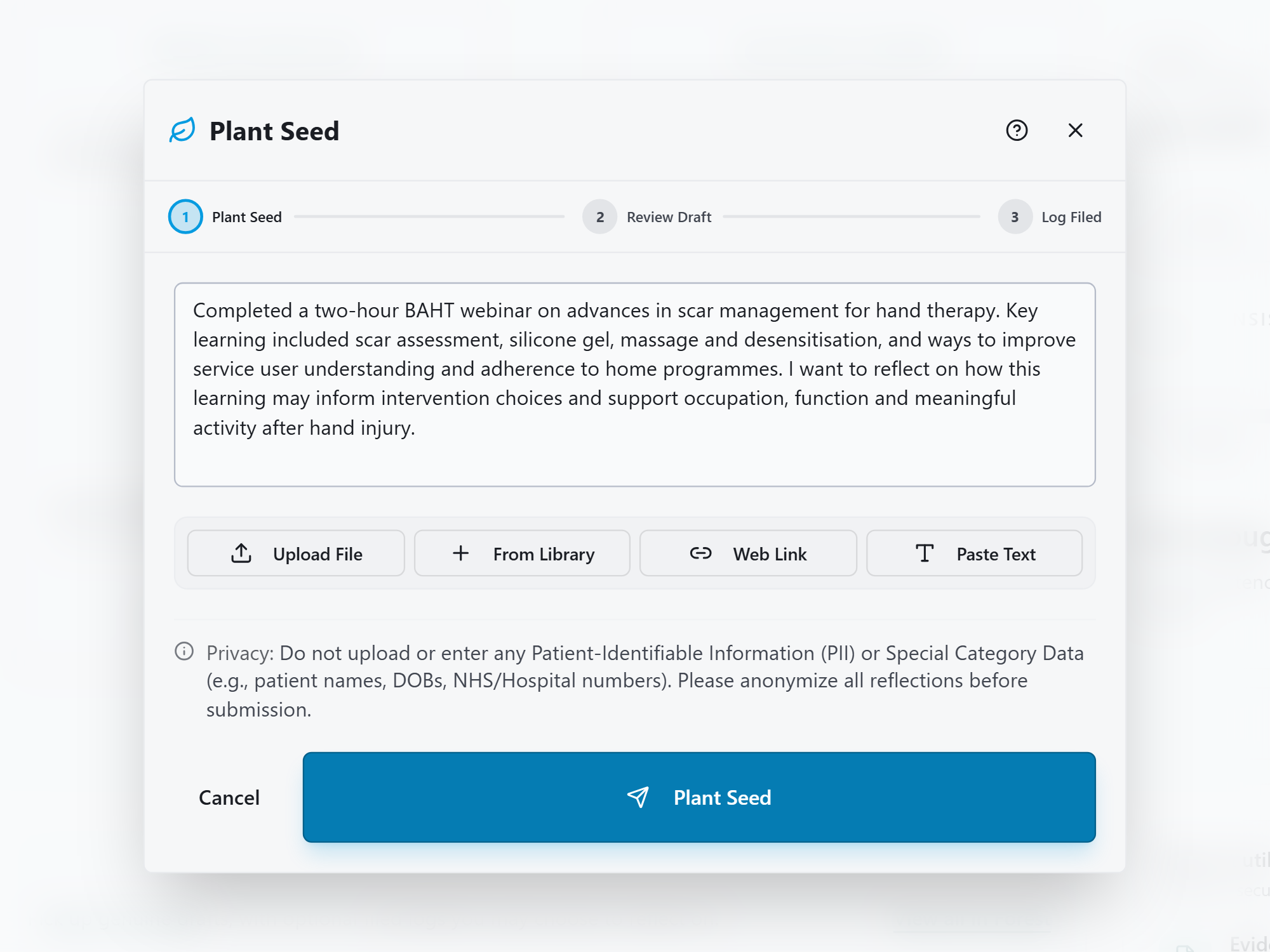
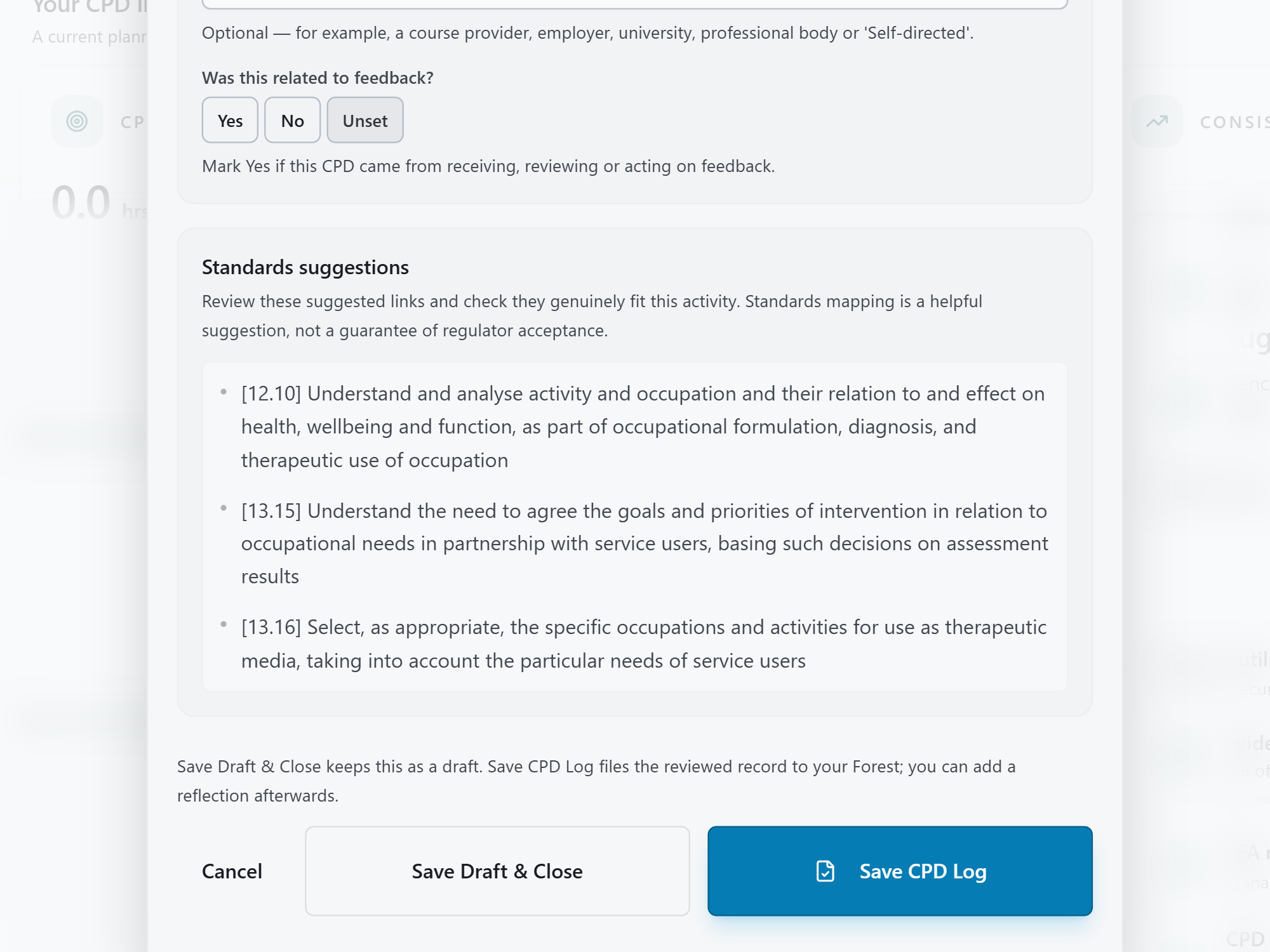
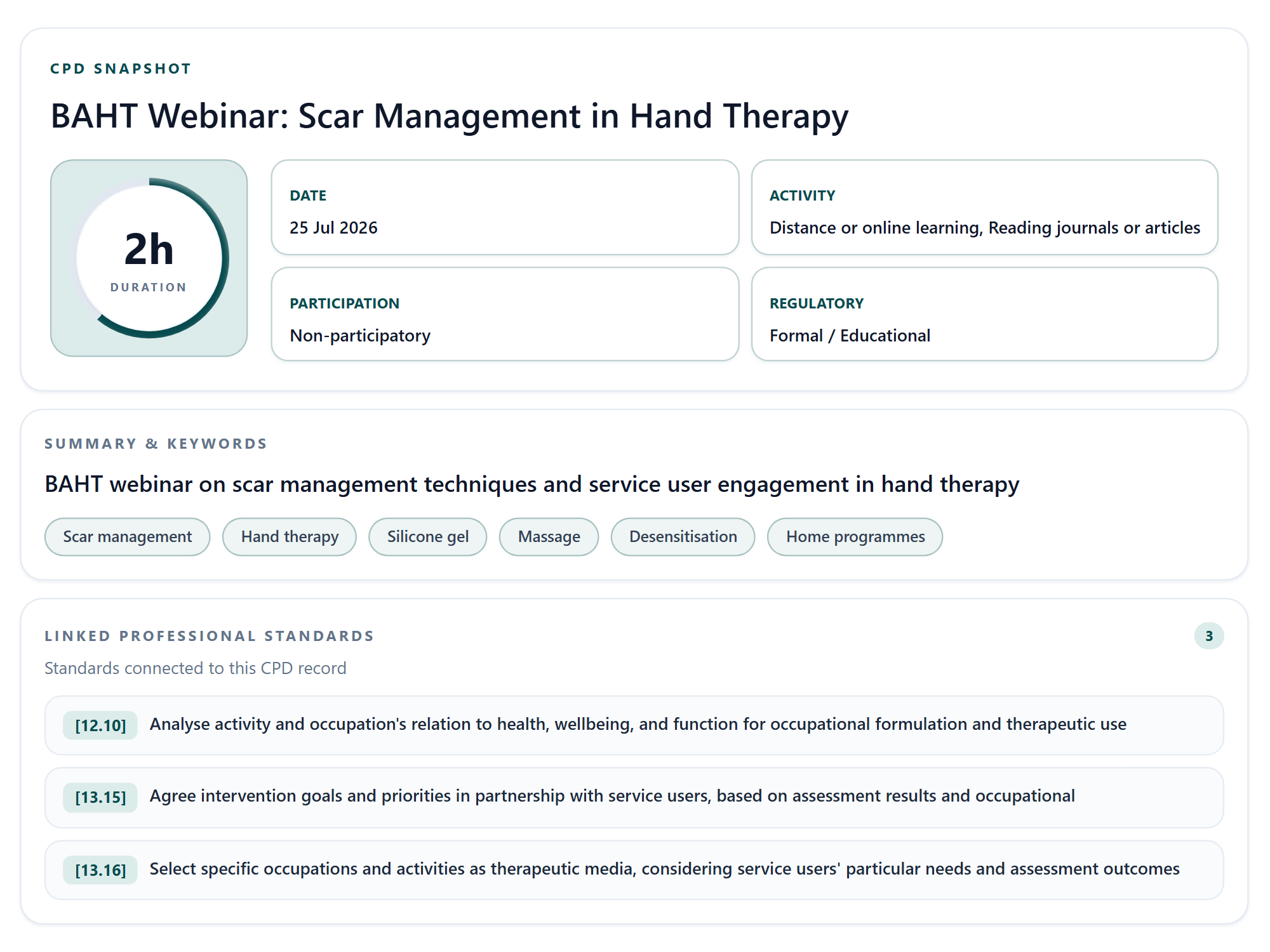
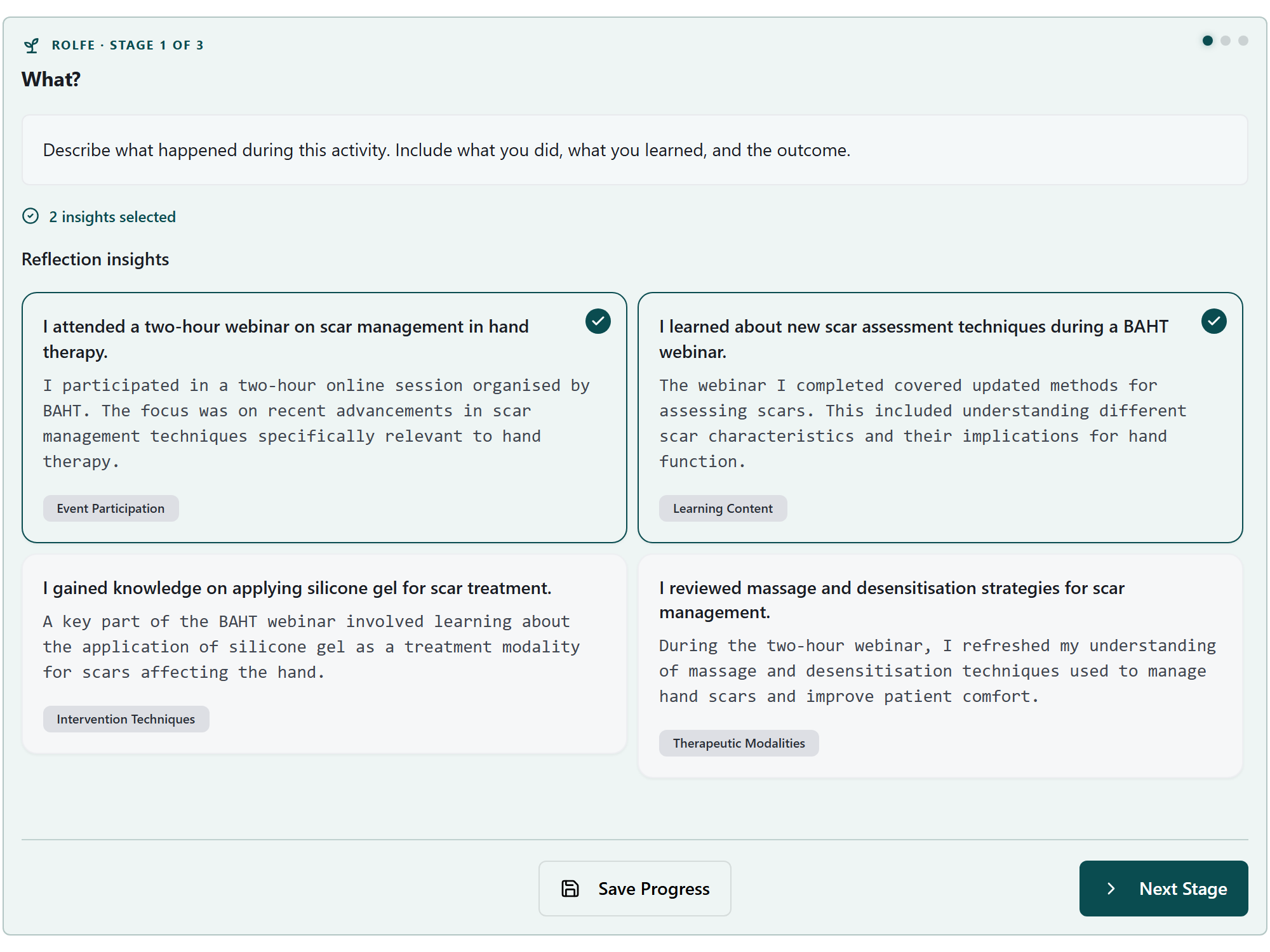
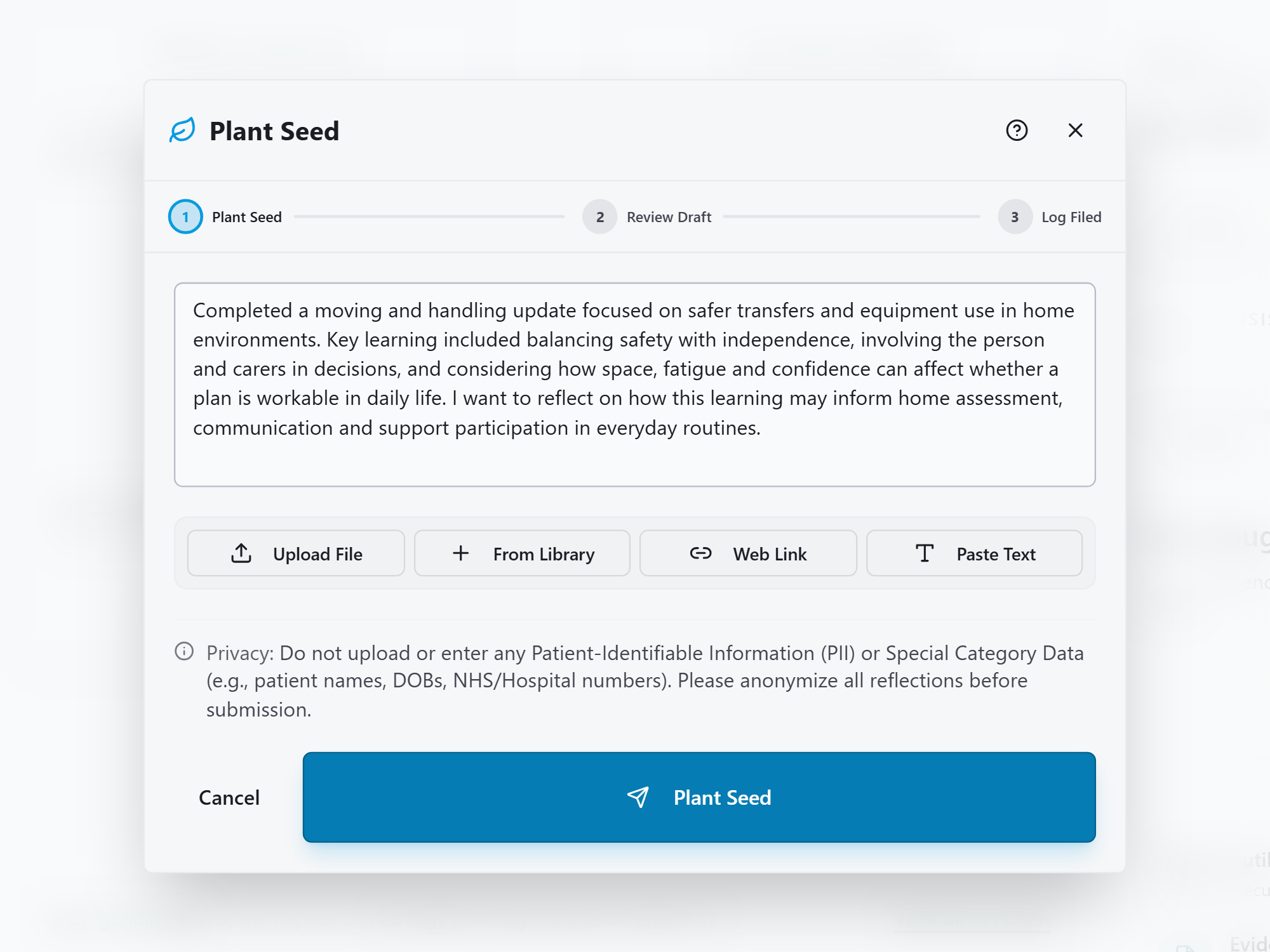
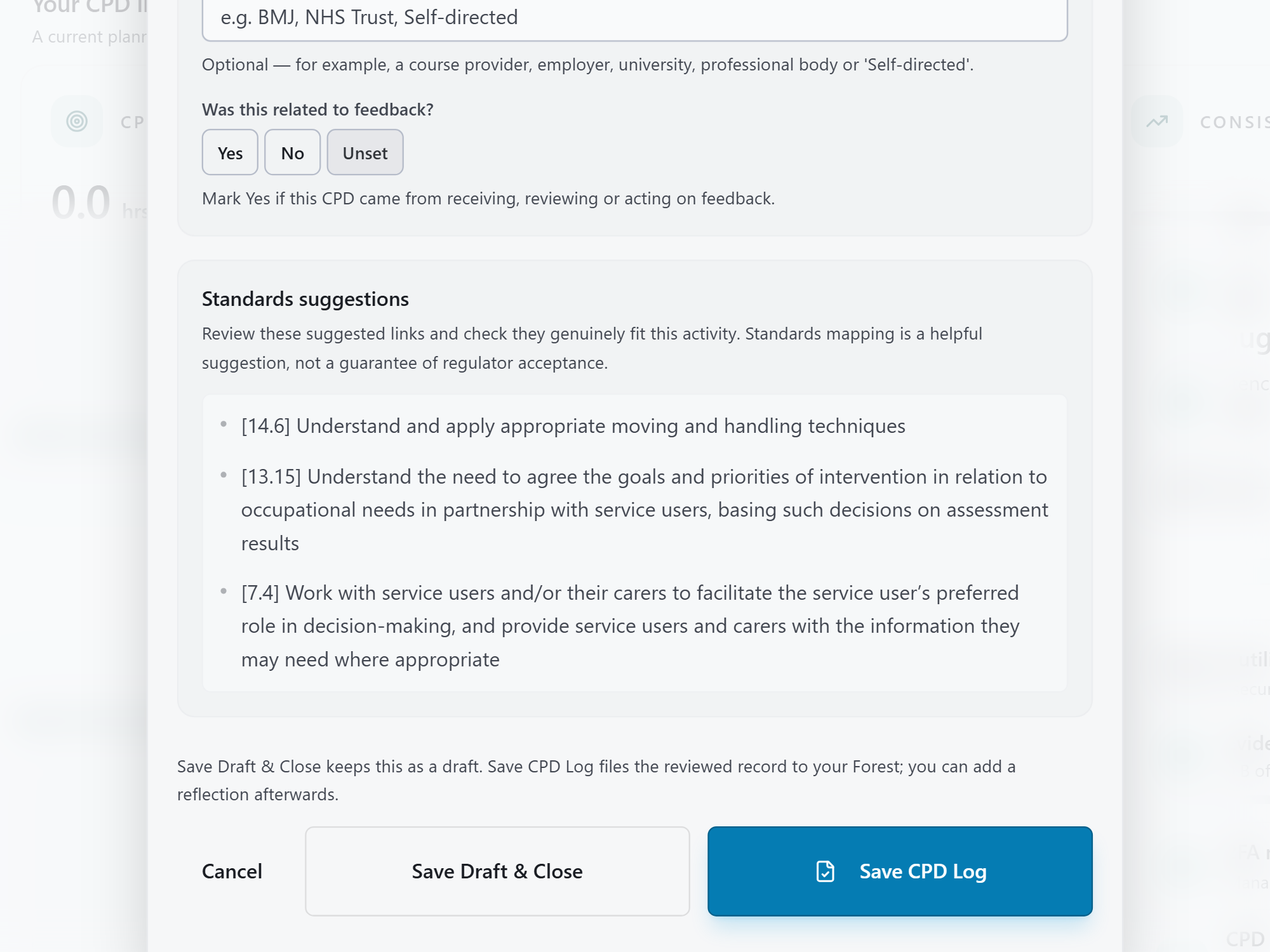
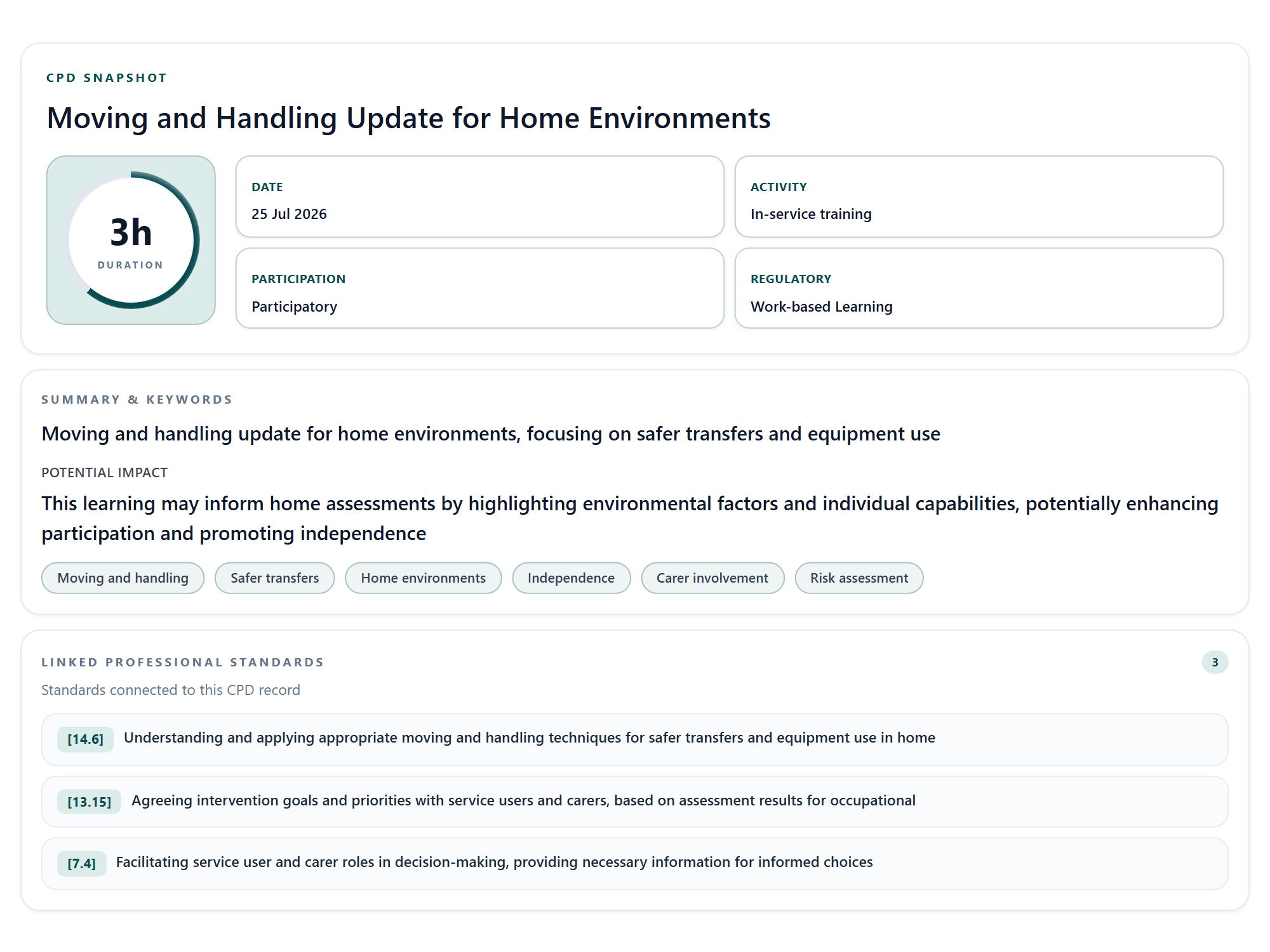
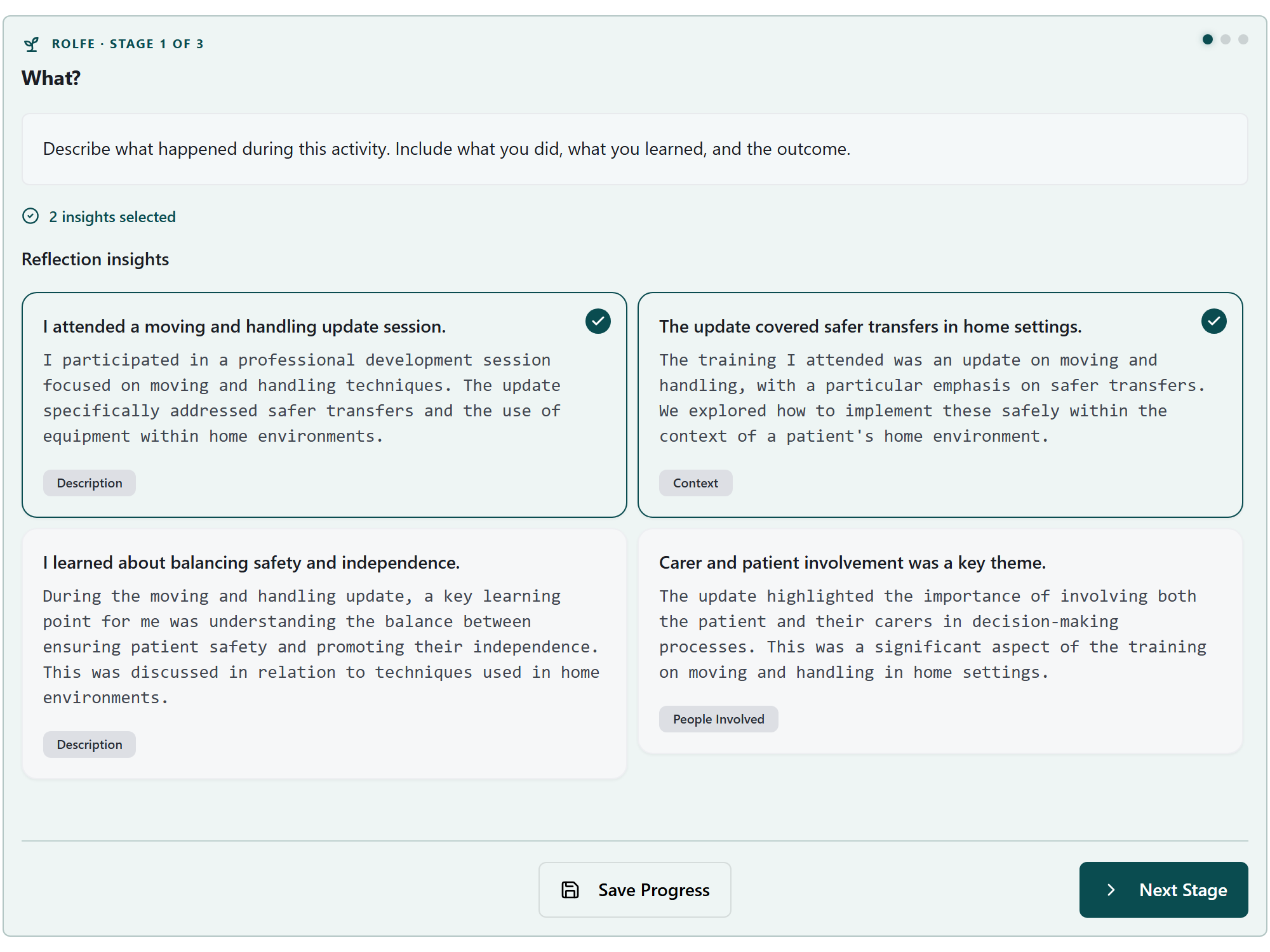
Each example follows the same HandyCPD journey: plant a seed, review and file a CPD log, view the CPD Snapshot, then develop a fuller reflection when that is useful. Screenshots below show that journey in HandyCPD for each fictional example. Do not copy text into your own CPD submission. Use the examples to see how learning can be linked to occupation, participation, environments and scope-aware practice.
For broader reflection writing, see how to write a CPD reflection, the Gibbs reflective cycle guide and the Rolfe reflection model guide. You may also find our physiotherapy CPD examples useful for a parallel HCPC-registrant walkthrough. Explore all guides on the resources hub.
What makes a good occupational therapy CPD example?
A strong occupational therapy CPD example usually shows more than attendance. It explains what learning took place, why it mattered to your role, setting or scope, and what changed in your thinking or practice.
- What learning took place and why it was relevant to your occupational therapy role or scope.
- How your reasoning, communication or practice changed as a result.
- How it may benefit service users where relevant.
- What evidence could support the record.
- What next steps follow from the learning.
Different activities need different levels of detail. Check current HCPC CPD guidance where relevant before submitting records or evidence.
Occupational therapy CPD template: what to include
This is not an official HCPC or RCOT template. It is a simple planning structure to help you think through what an occupational therapy CPD record might include before you write and review your own version. Check current professional guidance before submitting CPD records or evidence.
- Activity title and date
- Type of CPD activity
- Role, setting or scope relevance
- What you learned
- Reflection on impact
- Evidence or portfolio notes
- Next steps
A structured CPD log card can help capture the activity details before you build your reflection. If you use HandyCPD, supporting evidence can be kept alongside the CPD record in the Evidence Library.
RCOT CPD portfolio and reflective practice
Some occupational therapists search for RCOT CPD portfolio support when they are trying to organise learning, reflection and evidence in one place. HandyCPD is not affiliated with RCOT or HCPC, and official guidance should remain your source of truth.
RCOT CPD portfolio language can be useful when thinking about how learning, reflection and evidence fit together, but it does not replace RCOT guidance, HCPC requirements, official processes or your professional judgement. HandyCPD can help you organise CPD records, reflections and evidence in one digital portfolio that you review and approve.
If you use RCOT professional development resources, such as the Career Development Framework, treat them as official reference material and use HandyCPD only to organise your own records, reflections and evidence.
Compare the three occupational therapy CPD examples
The table below compares the three fictional examples so you can see how different occupational therapy learning activities can become CPD records, reflections and portfolio evidence.
| Example | CPD type | Reflection focus | Evidence ideas |
|---|---|---|---|
| Hand therapy scar management | Formal educational learning (BAHT webinar) | Scar management linked to occupation, function and therapeutic reasoning | Webinar certificate, anonymised notes, reflective summary |
| Community moving and handling | Work-based learning | Home risk assessment, equipment choices, carer communication | Session handouts, certificate, supervision notes, action plan |
| Sensory approaches (mental health) | Online formal learning | Sensory modulation, trauma-informed care, participation in routines | Course certificate, anonymised learning notes, reflective summary |
Example 1: Hand therapy occupational therapist (scar management)
Scenario
An occupational therapist working in hand therapy updates their knowledge of scar assessment, silicone gel application, desensitisation strategies and supporting service user adherence after hand trauma or surgery.
CPD activity
- Two-hour BAHT webinar on advances in scar management for hand therapy.
- Updated scar assessment protocols, evidence for silicone gel, massage and desensitisation.
- Methods to improve service user understanding and adherence to home programmes.
Reflection focus
- Linking evidence-informed scar management to assessment and treatment planning.
- Occupation, function and meaningful activity after hand injury.
- Service user education and home programme adherence.
- Therapeutic reasoning when choosing interventions.
- Scope-aware practice within hand therapy settings.
Example ways this learning could be applied in practice
These points are illustrative only. Adapt them to your own learning, role, setting and professional judgement.
- I developed a clearer understanding of how scar assessment findings can guide choices such as silicone gel, massage or desensitisation where appropriate.
- I would explain home programmes more clearly and check the person's understanding, confidence and ability to follow advice.
- This could help me adapt recommendations around meaningful activities and tolerance after hand injury.
- I identified that linking interventions to function and participation, not only technique lists, would strengthen my reasoning.
- My next step would be to discuss a complex case with a peer or update local educational guidance for home programmes.
How HandyCPD helps turn this learning into an organised CPD record
Valuable learning is easy to forget and much harder to evidence later. HandyCPD helps you capture it while it is fresh, then keep your CPD records, evidence and reflections together in one organised digital portfolio. AI-supported prompts make drafting and structuring easier, while Analytics helps you see themes and gaps as your learning grows. You remain in control of every record, with everything easier to review and retrieve if you are selected for audit.
For this activity, HandyCPD could help connect learning about scar management with occupation, function, service user education and practical next steps.
Walkthrough in HandyCPD
Step 1: Plant a Seed
Step 2: Review and file your CPD log
Step 3: View your CPD Snapshot
Step 4: Develop a fuller reflection when useful
Example 2: Community occupational therapist (safer moving and handling at home)
Scenario
A community occupational therapist completes moving and handling CPD to improve confidence with complex home assessments, equipment recommendations, carer wellbeing and clear communication about risk in people’s own environments.
CPD activity
- Half-day moving and handling update focused on complex community situations.
- Risk assessment, hoist and sling selection, bed and chair transfers.
- Single-handed care considerations, documentation and communicating risk with service users, families and care providers.
Reflection focus
- Risk assessment and risk enablement in varied home environments.
- Equipment choices that support independence and safe participation.
- Carer wellbeing and family communication.
- Documentation that reflects assessment and agreed plans.
- Therapeutic reasoning when standard protocols do not fit the environment.
Example ways this learning could be applied in practice
These points are illustrative only. Adapt them to your own learning, role, setting and professional judgement.
- I developed a clearer understanding of how to balance safety, independence and the realities of the home environment.
- I would involve the person and carers more explicitly when deciding on equipment, transfers and daily routines.
- This could help me weigh space, fatigue, cognition, confidence and other factors that affect whether a plan is workable at home.
- I identified ways to support safer participation without removing choice unnecessarily.
- My next step would be to use supervision or peer discussion for a complex moving and handling decision.
How HandyCPD helps turn this learning into an organised CPD record
Valuable learning is easy to forget and much harder to evidence later. HandyCPD helps you capture it while it is fresh, then keep your CPD records, evidence and reflections together in one organised digital portfolio. AI-supported prompts make drafting and structuring easier, while Analytics helps you see themes and gaps as your learning grows. You remain in control of every record, with everything easier to review and retrieve if you are selected for audit.
For this activity, HandyCPD could help bring together home assessment findings, equipment decisions, communication with carers and reflection on balancing safety with independence.
Walkthrough in HandyCPD
Step 1: Plant a Seed
Step 2: Review and file your CPD log
Step 3: View your CPD Snapshot
Step 4: Develop a fuller reflection when useful
Example 3: Mental health occupational therapist (sensory approaches and emotional regulation)
Scenario
A mental health occupational therapist develops their use of sensory approaches to support emotional regulation and participation in meaningful daily routines, roles and occupations.
CPD activity
- Online training on sensory modulation and emotional regulation in mental health OT practice.
- Sensory preferences, grounding strategies, sensory assessment tools and trauma-informed approaches.
- Linking sensory regulation to daily routines, roles and participation.
Reflection focus
- Sensory modulation and emotional regulation in therapeutic reasoning.
- Trauma-informed communication and safe practice.
- Supporting participation in meaningful activity and routines.
- Scope-aware use of sensory assessment tools.
- Confidentiality and avoiding unnecessary identifiable detail in records.
Example ways this learning could be applied in practice
These points are illustrative only. Adapt them to your own learning, role, setting and professional judgement.
- I developed a clearer understanding of how sensory preferences may influence regulation, routines and participation.
- I would use more collaborative questions and individualised strategies rather than one-size-fits-all approaches.
- This could help me keep trauma-informed practice in view when exploring sensory strategies with people.
- I identified links between sensory approaches, meaningful activities and everyday routines that I want to explore further.
- My next step would be to review how a person responds to a strategy and adapt the approach with them.
How HandyCPD helps turn this learning into an organised CPD record
Valuable learning is easy to forget and much harder to evidence later. HandyCPD helps you capture it while it is fresh, then keep your CPD records, evidence and reflections together in one organised digital portfolio. AI-supported prompts make drafting and structuring easier, while Analytics helps you see themes and gaps as your learning grows. You remain in control of every record, with everything easier to review and retrieve if you are selected for audit.
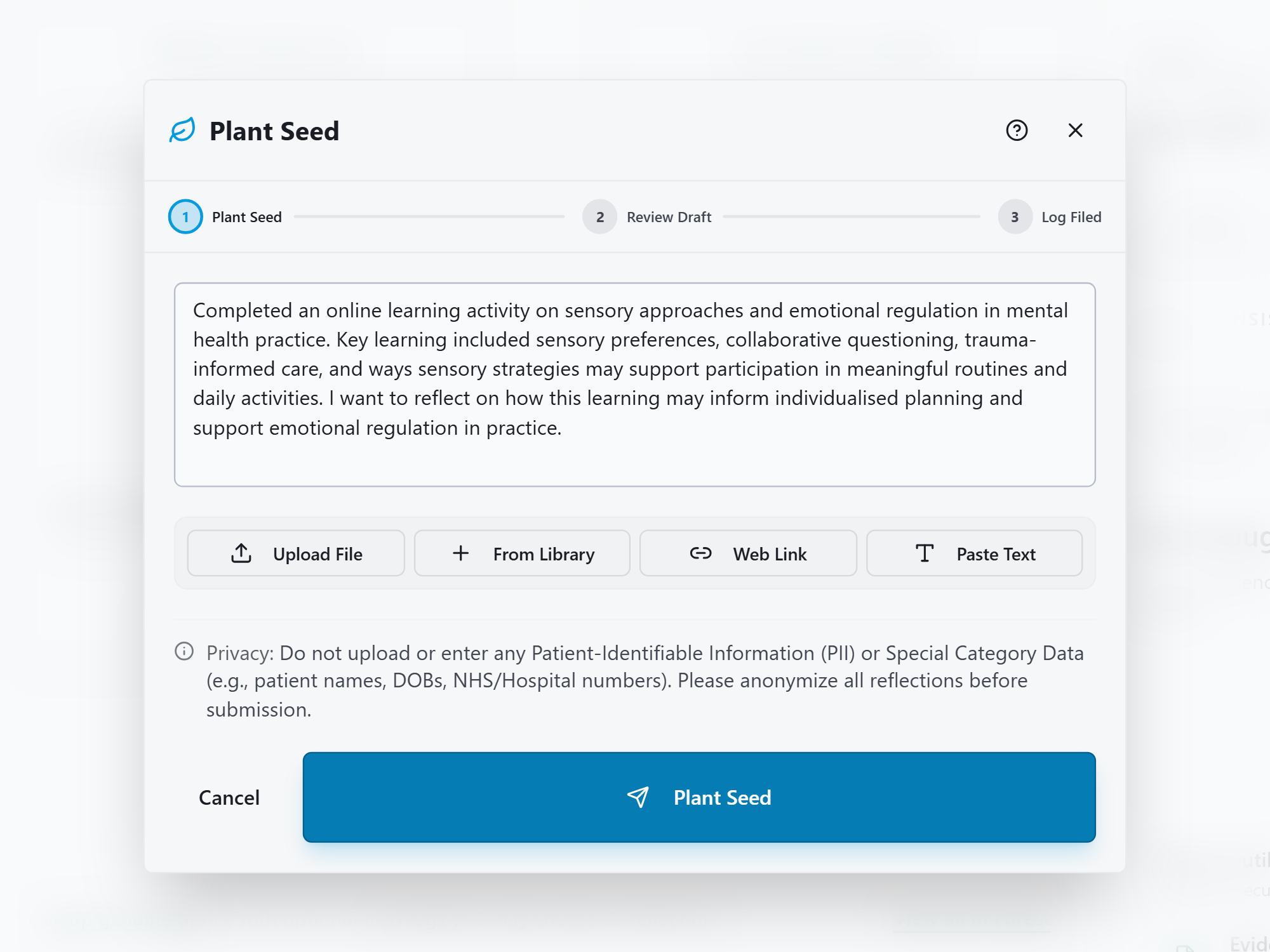
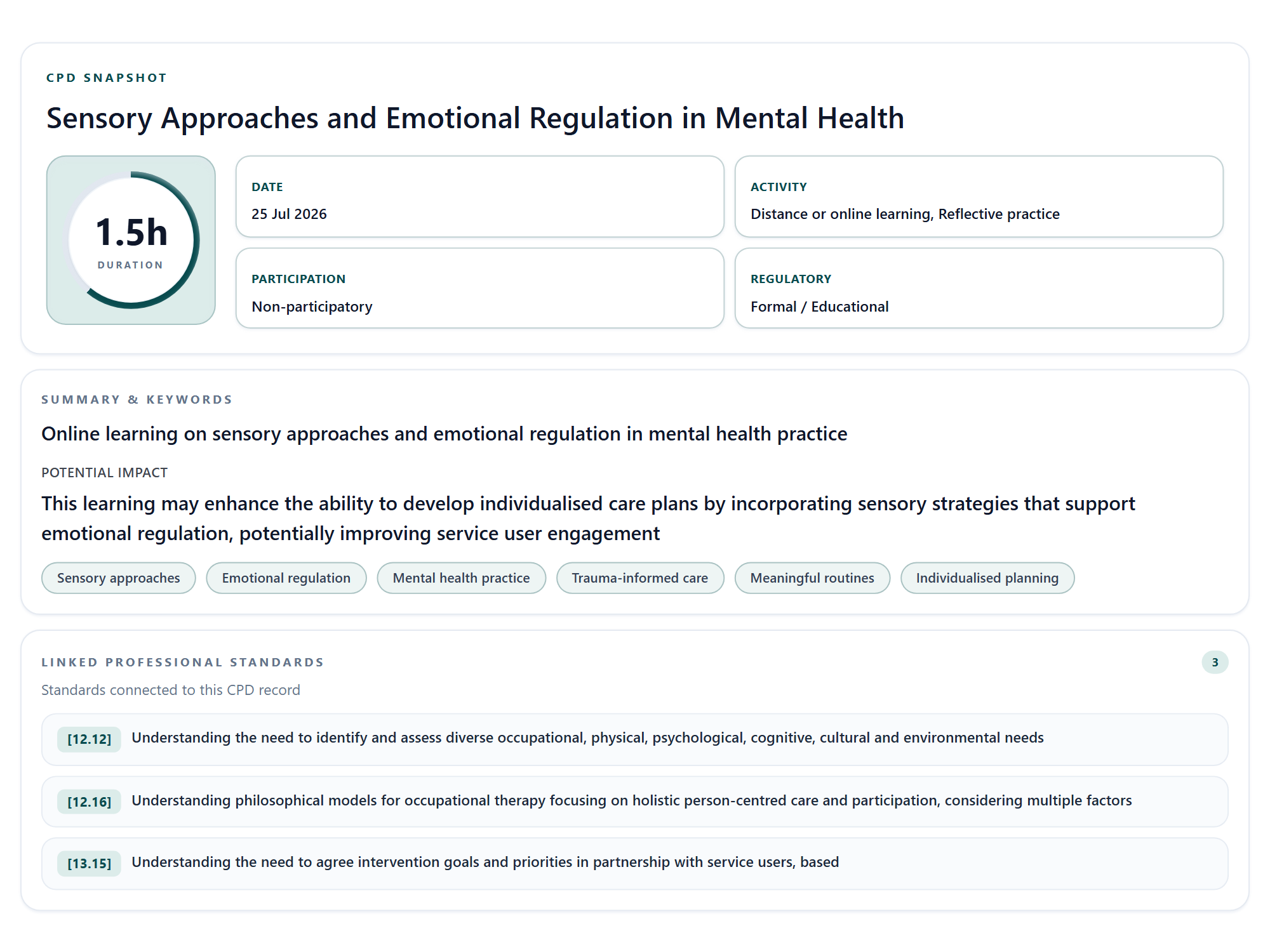
For this activity, HandyCPD could help organise learning about sensory approaches, trauma-informed practice, collaborative planning and participation in meaningful routines.
Walkthrough in HandyCPD
Step 1: Plant a Seed
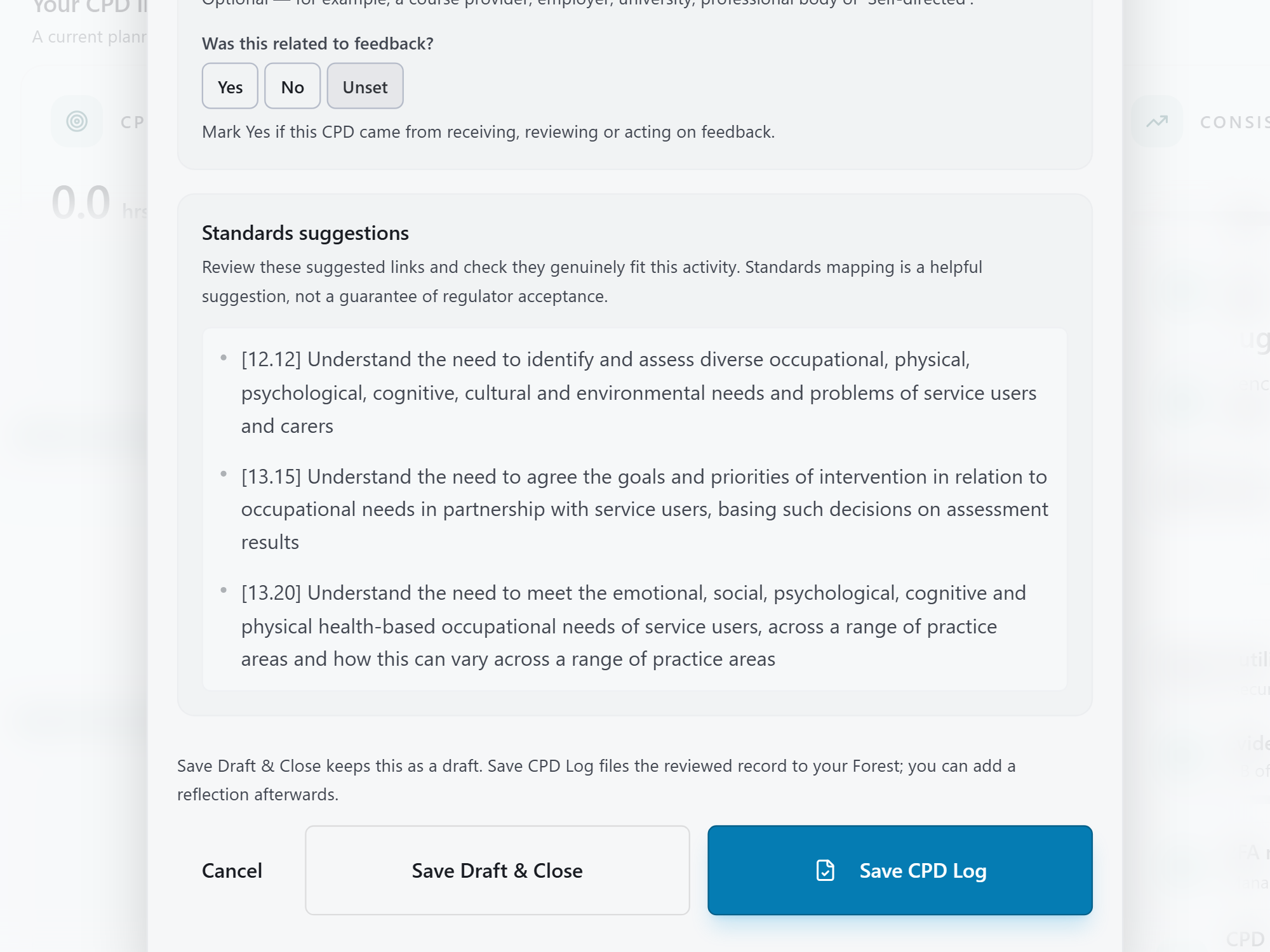
Step 2: Review and file your CPD log
Step 3: View your CPD Snapshot
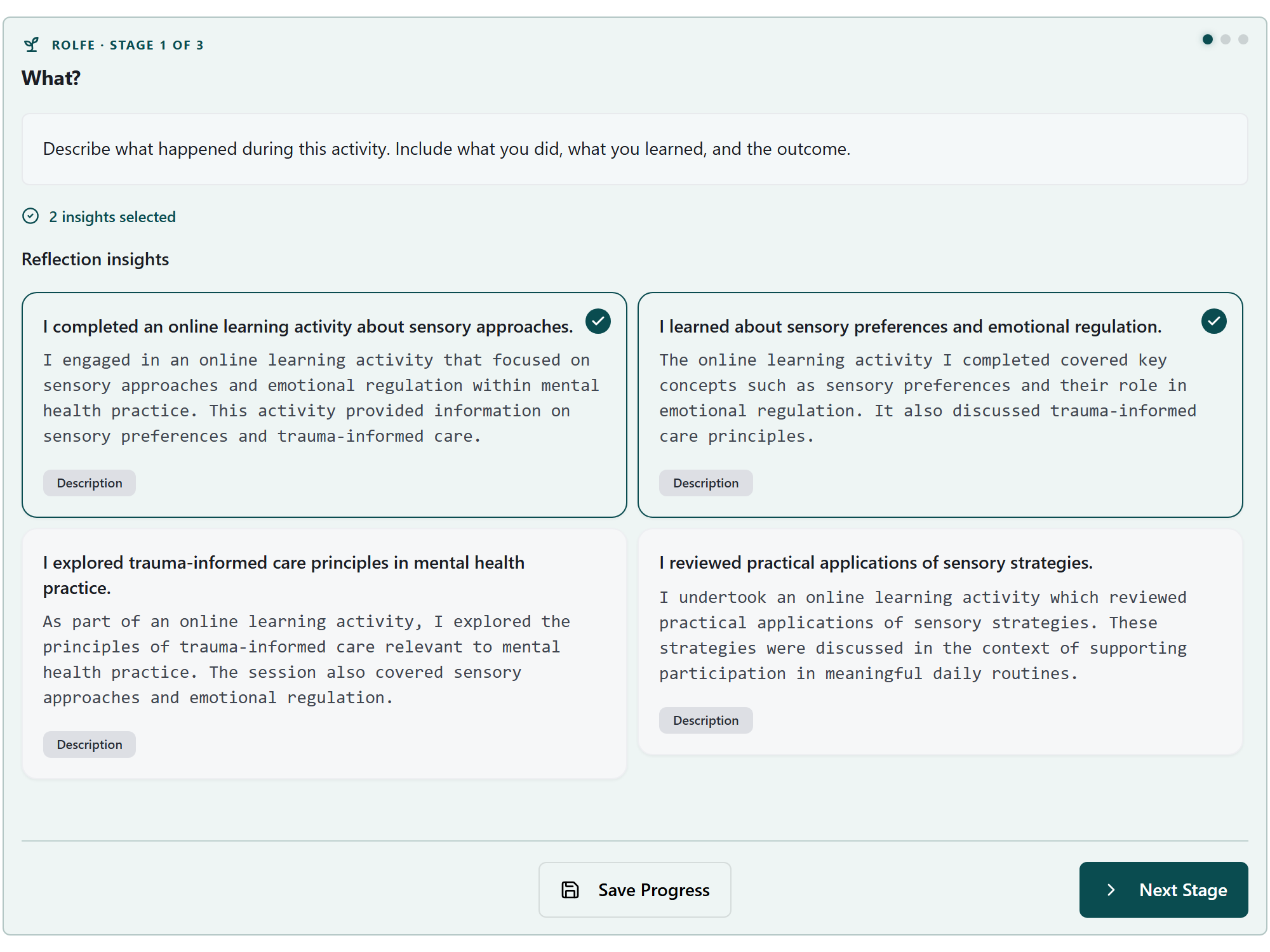
Step 4: Develop a fuller reflection when useful
Occupational therapy CPD examples FAQ
Can I copy these occupational therapy CPD examples?
No. They are fictional examples for learning support only. Use them to understand structure, then write your own CPD record based on your role, scope, learning, evidence and professional judgement.
Do occupational therapists need CPD for HCPC?
UK occupational therapists are HCPC registrants and must meet HCPC CPD requirements. For general expectations and how to prepare records, see our HCPC CPD guide and the official HCPC resources linked below.
What should an occupational therapy CPD reflection include?
It should explain what you learned, why it mattered to your role or setting, how your thinking or practice changed, how it may benefit service users where relevant, and what you will do next. For broader reflection writing guidance, see how to write a CPD reflection.
Can HandyCPD help with an RCOT CPD portfolio?
HandyCPD can help organise CPD records, reflections and evidence in a portfolio-style workflow. It is not affiliated with RCOT and does not replace RCOT guidance, HCPC requirements or your professional judgement.
Are these examples official HCPC or RCOT templates?
No. They are educational examples, not official templates or guaranteed submission wording. Check current HCPC and RCOT guidance, adapt records to your own practice and avoid identifiable or confidential information.
Ready to build occupational therapy CPD records like these examples?
Follow the same workflow with your own anonymised learning. You review every record before filing.
30-day Pro trial. No card required.