
CPD RESOURCE
Physiotherapy CPD examples: ICU, sports rehabilitation and pelvic pain
This page walks through three fictional physiotherapy CPD examples from ICU, sports rehabilitation and specialist pelvic health settings. Each example outlines possible reflection themes, how the learning could influence practice, and how the activity could be recorded and developed in HandyCPD.
The examples are fictional. Do not copy them into your own portfolio or professional submission. Adapt the structure to your role, scope, learning and evidence. UK physiotherapists must meet HCPC CPD requirements; for general expectations, see our HCPC CPD guide. HandyCPD supports structure and reflection drafting; you remain responsible for reviewing, editing and approving every record.
Resources support CPD learning and organisation. You review and approve every record.
How to use these examples
Each example follows the same HandyCPD journey: plant a seed, review and file a CPD log, view the CPD Snapshot, then develop a fuller reflection when that is useful. Screenshots below show that journey in HandyCPD for each fictional example. Do not copy text into your own CPD submission. Use the examples to see how learning can be linked to clinical reasoning, communication and next steps.
For broader reflection writing, see how to write a CPD reflection, the Gibbs reflective cycle guide and the Rolfe reflection model guide. You may also find our occupational therapy CPD examples useful for a parallel HCPC-registrant walkthrough. Explore all guides on the resources hub.
What makes a good physiotherapy CPD example?
A strong physiotherapy CPD example usually shows more than attendance. It explains what learning took place, why it mattered to your role or scope, and what changed in your thinking or practice.
- What learning took place and why it was relevant to your physiotherapy role or scope.
- How your thinking or practice changed as a result.
- How it may benefit patients or service users where relevant.
- What evidence could support the record.
- What next steps follow from the learning.
Different activities need different levels of detail. Check current HCPC CPD guidance where relevant before submitting records or evidence.
Physiotherapy CPD template: what to include
This is not an official HCPC or CSP template. It is a simple planning structure to help you think through what a physiotherapy CPD record might include before you write and review your own version. Check current professional guidance before submitting CPD records or evidence.
- Activity title and date
- Type of CPD activity
- Role or scope relevance
- What you learned
- Reflection on impact
- Evidence attached or stored
- Next steps
A structured CPD log can help capture the activity details before you decide whether deeper reflection would help. If you use HandyCPD, supporting evidence can be kept alongside the CPD record in the Evidence Library.
Compare the three physiotherapy CPD examples
The table below compares the three fictional examples so you can see how different physiotherapy learning activities can be recorded, reflected on and supported with evidence.
| Example | CPD type | Reflection focus | Evidence ideas |
|---|---|---|---|
| ICU ABG interpretation | Work-based learning | Clinical reasoning, escalation, patient safety | Teaching notes, supervision notes, anonymised learning notes |
| Sports rehabilitation and return-to-play | Conference or formal learning | Return-to-play decisions, rehabilitation progressions, MDT communication | Certificate, programme, notes, action plan |
| Persistent pelvic pain and trauma-informed care | Online course or specialist learning | Biopsychosocial reasoning, trauma-informed communication, scope-aware practice | Course certificate, reading notes, reflective summary |
Example 1: Band 5 rotational physiotherapist (ICU ABG interpretation)
Scenario
A Band 5 physiotherapist on an ICU rotation attends in-house teaching on arterial blood gas (ABG) interpretation. The learning is participatory, ward-based and relevant to assessing acutely unwell patients.
CPD activity
- In-house ABG interpretation teaching session led by an ICU clinical educator.
- Structured approach to acid-base balance using anonymised clinical examples.
- Approximately 1.5 hours of work-based learning.
Reflection focus
- Confidence interpreting ABG results in a systematic way.
- Clinical reasoning when acid-base patterns are complex.
- Patient safety and knowing when to escalate or seek senior input.
- Communication with ICU colleagues about physiological findings.
- Using supervision to consolidate learning on complex cases.
Example ways this learning could be applied in practice
These illustrative points show one possible direction for applying the learning. Adapt them to your own role, scope and experience rather than copying the wording.
- I developed a clearer understanding of how to interpret ABGs using a more systematic approach to acid-base balance.
- I identified when complex patterns would prompt me to escalate or seek senior input rather than relying on incomplete reasoning.
- I would communicate physiological findings more clearly with ICU colleagues, including what is known and what remains uncertain.
- This could help me support safer clinical reasoning in acutely unwell patients without overstating certainty.
- My next step would be to apply the method to further anonymised examples and discuss a complex case in supervision.
How HandyCPD helps turn this learning into an organised CPD record
Valuable learning is easy to forget and much harder to evidence later. HandyCPD helps you capture it while it is fresh, then keep your CPD records, evidence and reflections together in one organised digital portfolio. AI-supported prompts make drafting and structuring easier, while Analytics helps you see themes and gaps as your learning grows. You remain in control of every record, with everything easier to review and retrieve if you are selected for audit.
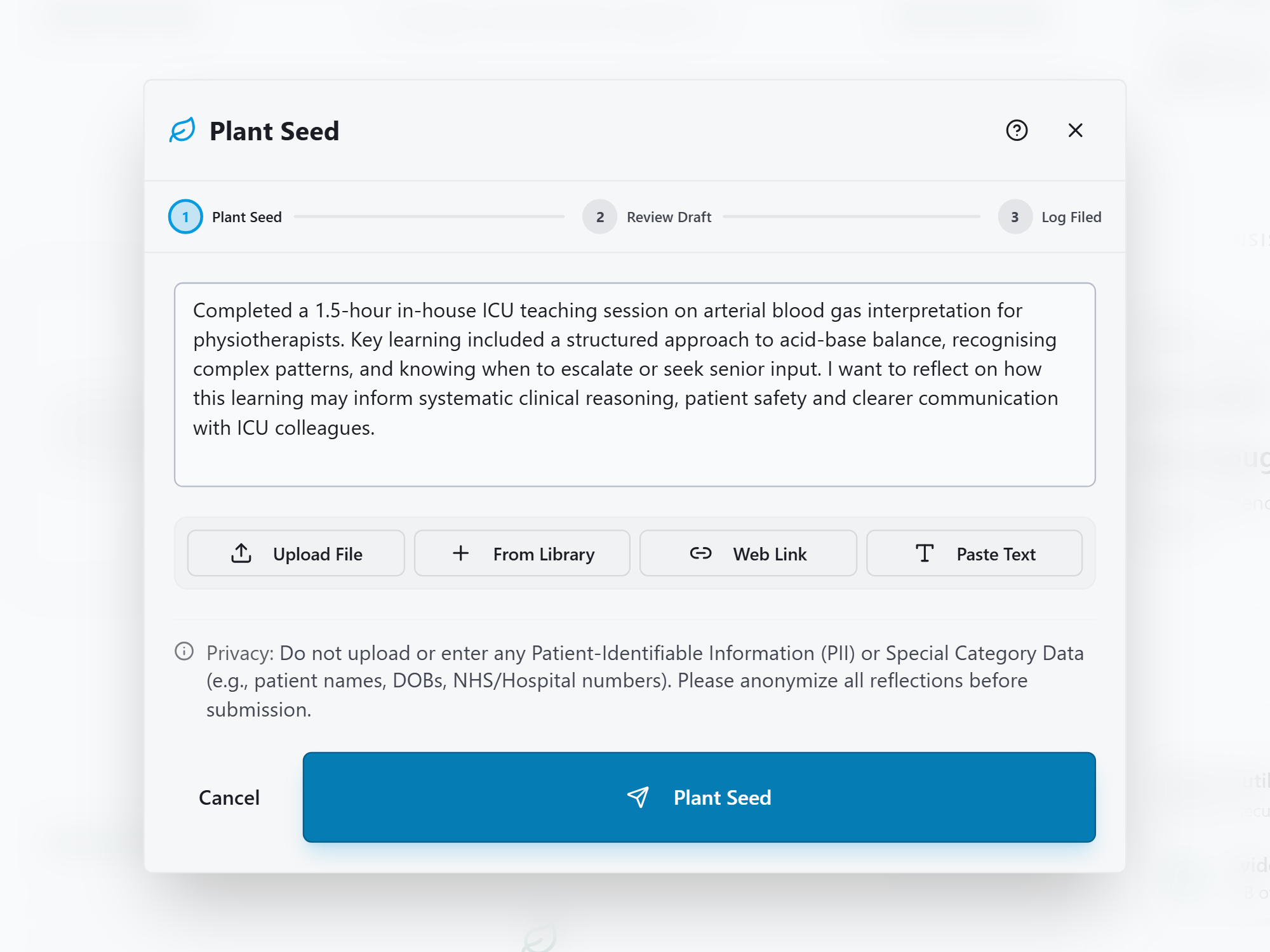
For this activity, HandyCPD could help connect ABG interpretation learning with systematic clinical reasoning, patient safety, escalation and communication with ICU colleagues.
Walkthrough in HandyCPD
Step 1: Plant a Seed
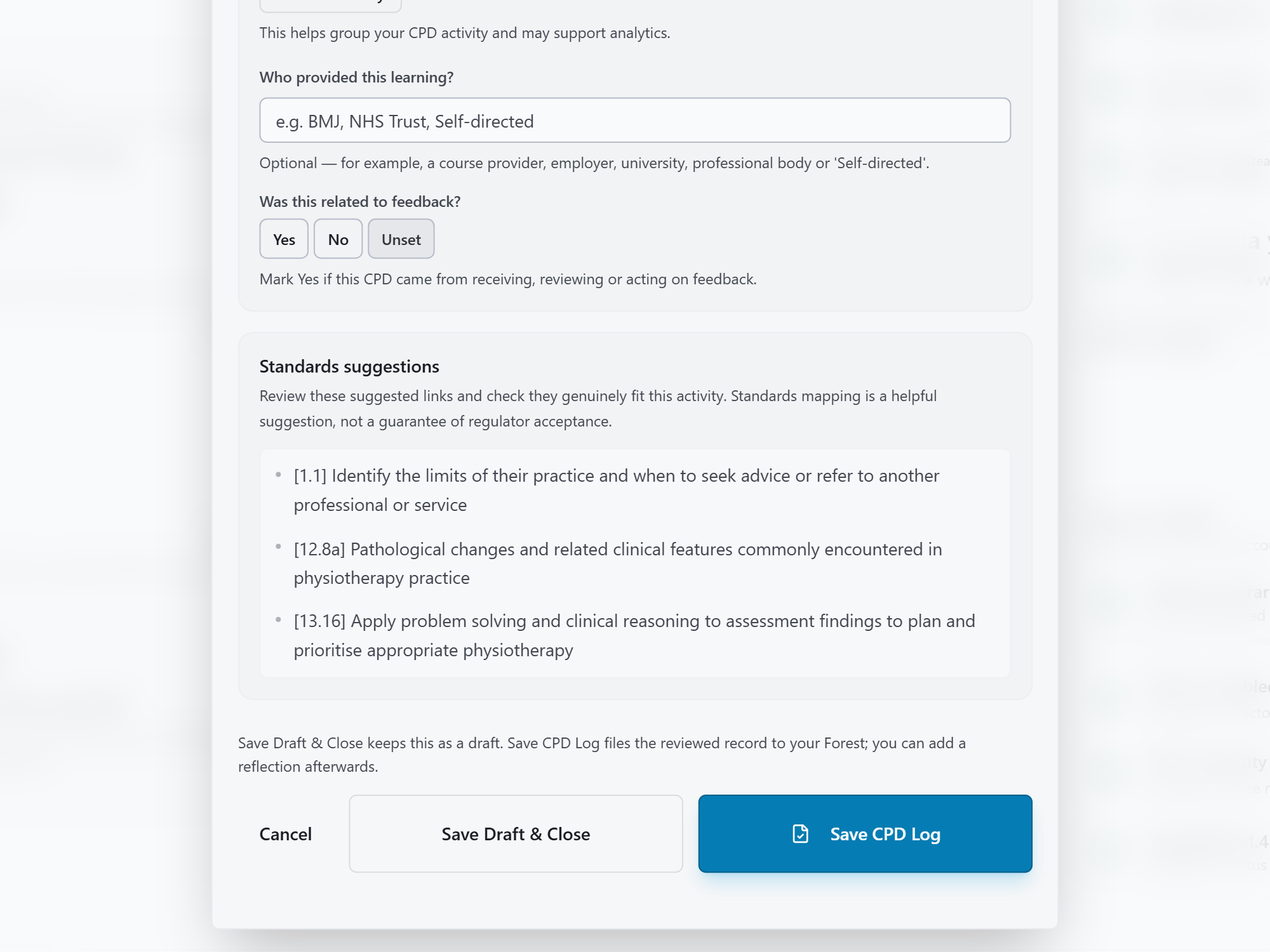
Step 2: Review and file your CPD log
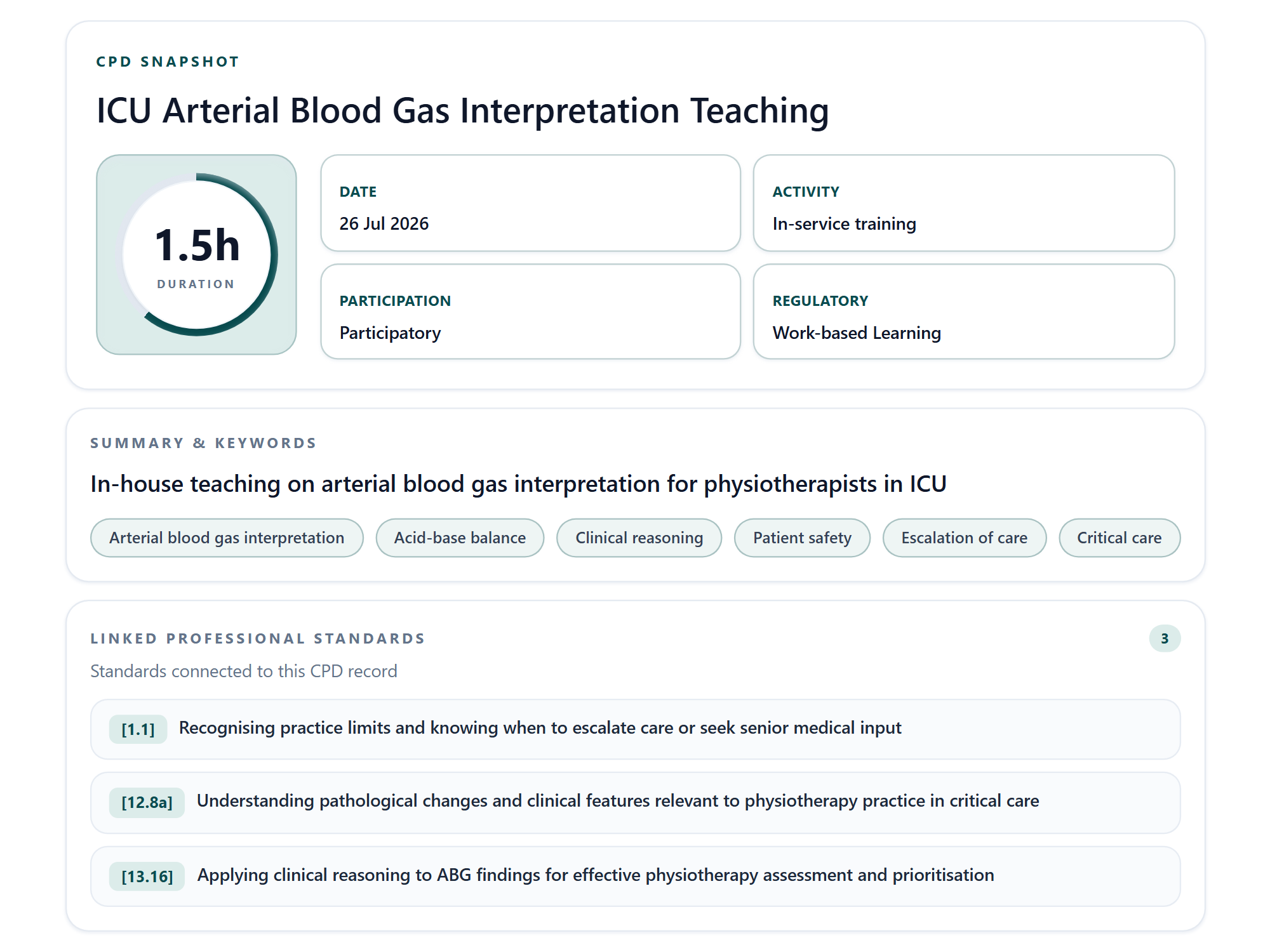
Step 3: View your CPD Snapshot
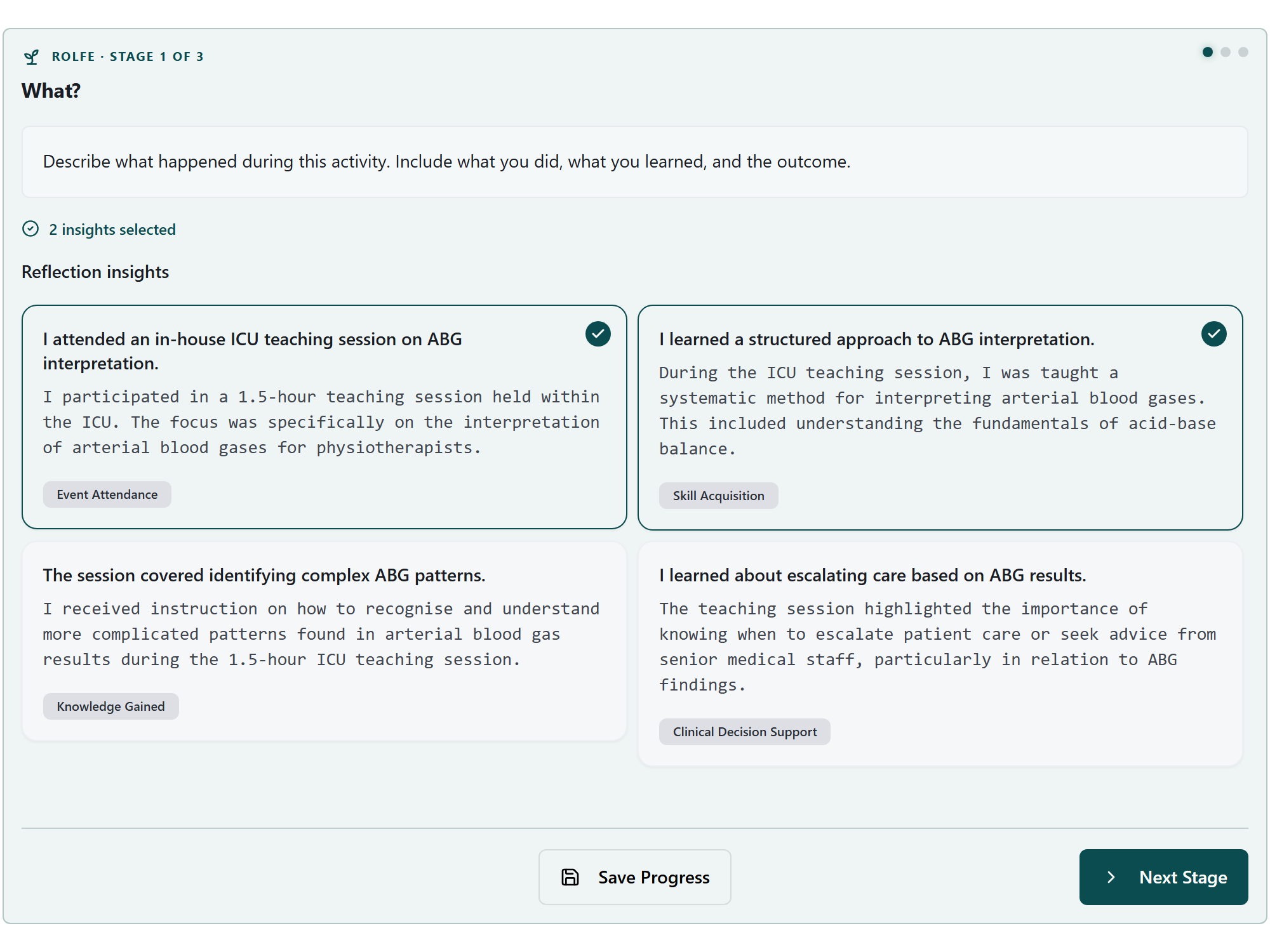
Step 4: Develop a fuller reflection when useful
Example 2: Senior physiotherapist (sports rehabilitation and return-to-play)
Scenario
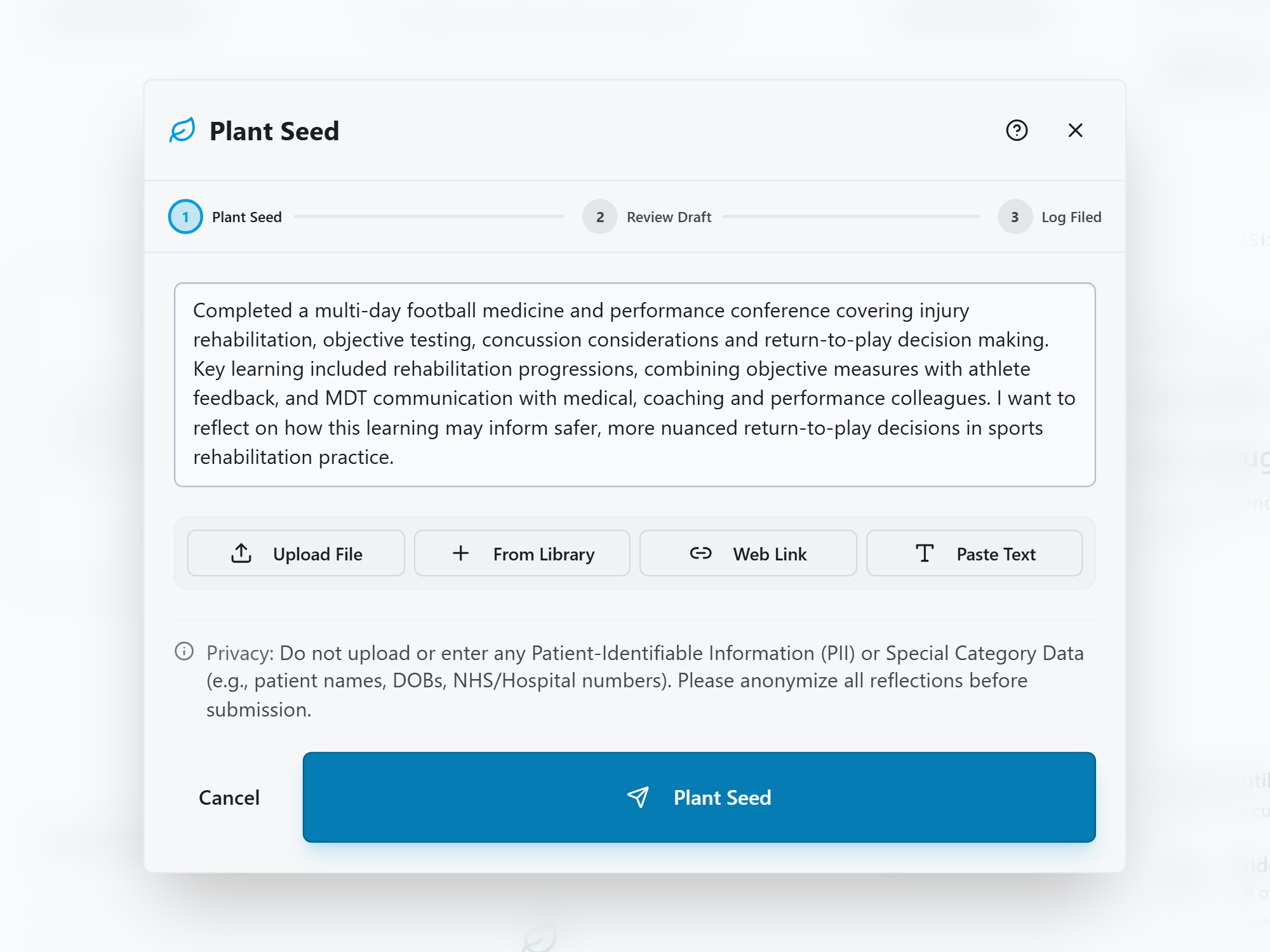
A senior physiotherapist working in sports rehabilitation attends a multi-day conference on football medicine and performance. The learning spans injury rehabilitation, concussion, data-informed practice and return-to-play decision making.
CPD activity
- Three-day Football Medicine & Performance Conference with lectures, panels and practical sessions.
- Topics include hamstring and ACL rehabilitation, concussion management and injury prevention analytics.
- Formal educational CPD with participatory elements.
Reflection focus
- Evidence-informed rehabilitation progressions for complex sports injuries.
- Objective and functional testing alongside subjective athlete feedback.
- MDT communication with medical staff, coaches and performance teams.
- Safer, more nuanced return-to-play decisions.
- Staying current in a fast-moving sports science field.
Example ways this learning could be applied in practice
These illustrative points show one possible direction for applying the learning. Adapt them to your own role, scope and experience rather than copying the wording.
- I developed a clearer understanding of rehabilitation progressions and how objective and functional testing can sit alongside athlete feedback.
- I identified conference themes most relevant to my caseload rather than trying to apply every recommendation indiscriminately.
- I would communicate return-to-play rationale and uncertainty more clearly within the MDT.
- This could help me weigh loading strategies and decision points with greater care for the athlete in front of me.
- My next step would be to review current return-to-play criteria with colleagues or discuss how selected learning applies in clinic or pitch-side practice.
How HandyCPD helps turn this learning into an organised CPD record
Valuable learning is easy to forget and much harder to evidence later. HandyCPD helps you capture it while it is fresh, then keep your CPD records, evidence and reflections together in one organised digital portfolio. AI-supported prompts make drafting and structuring easier, while Analytics helps you see themes and gaps as your learning grows. You remain in control of every record, with everything easier to review and retrieve if you are selected for audit.
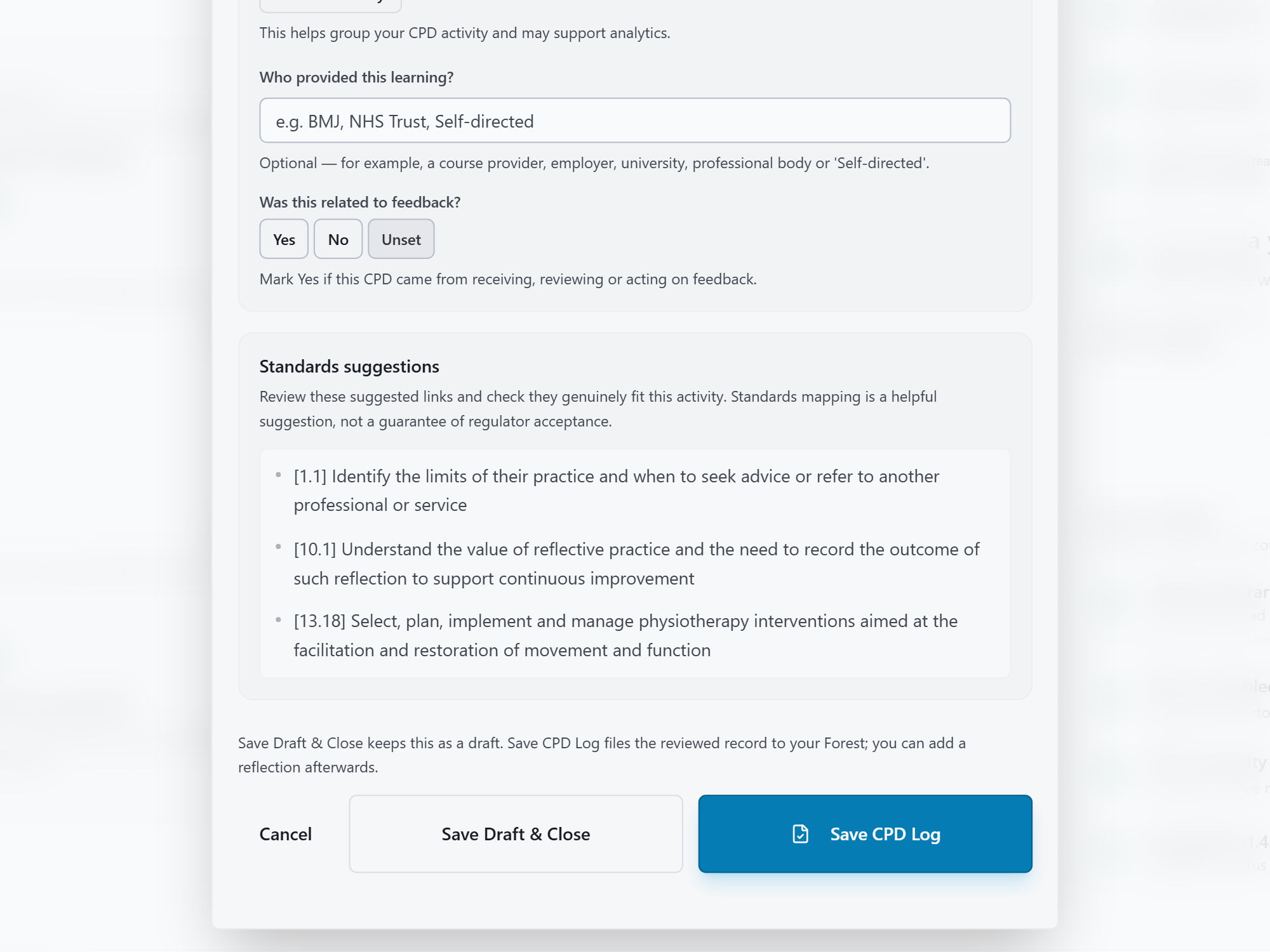
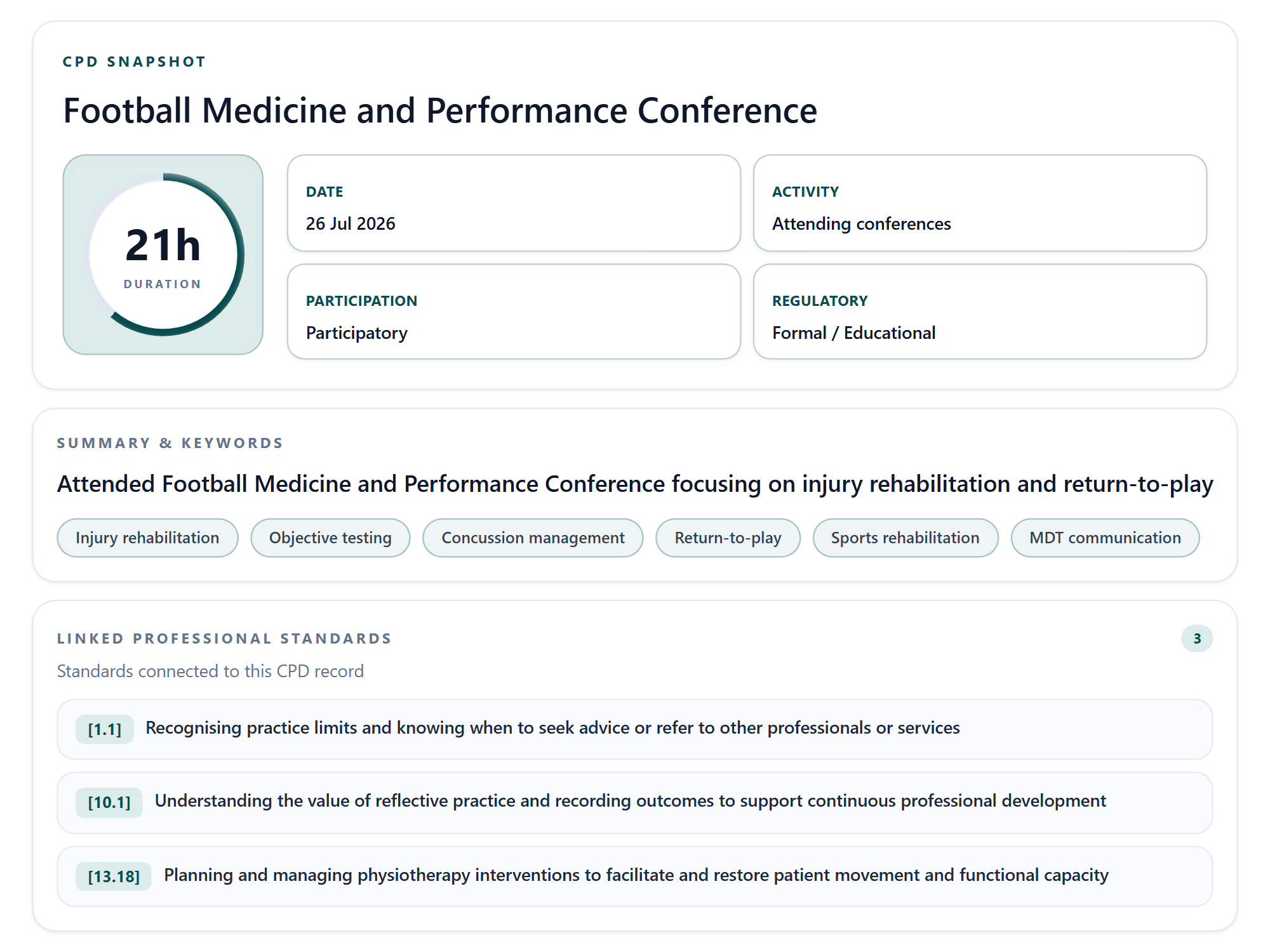
For this activity, HandyCPD could help organise conference learning around rehabilitation progressions, objective testing, MDT communication and safer return-to-play decisions.
Walkthrough in HandyCPD
Step 1: Plant a Seed
Step 2: Review and file your CPD log
Step 3: View your CPD Snapshot
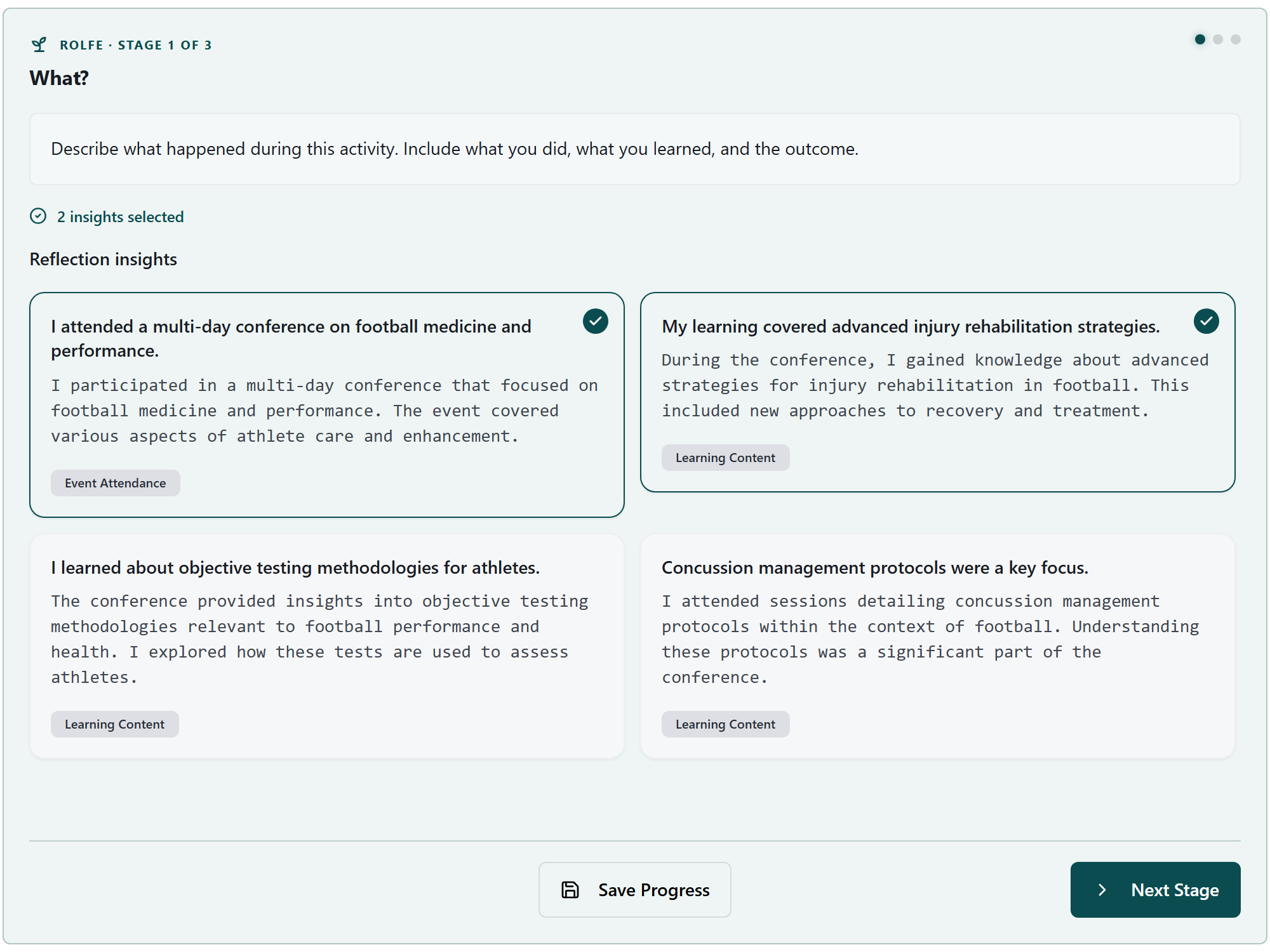
Step 4: Develop a fuller reflection when useful
Example 3: Clinical specialist (persistent pelvic pain and trauma-informed care)
Scenario
A clinical specialist physiotherapist in women's health completes advanced online learning on biopsychosocial approaches to persistent pelvic pain, including pain neuroscience, central sensitisation and trauma-informed care.
CPD activity
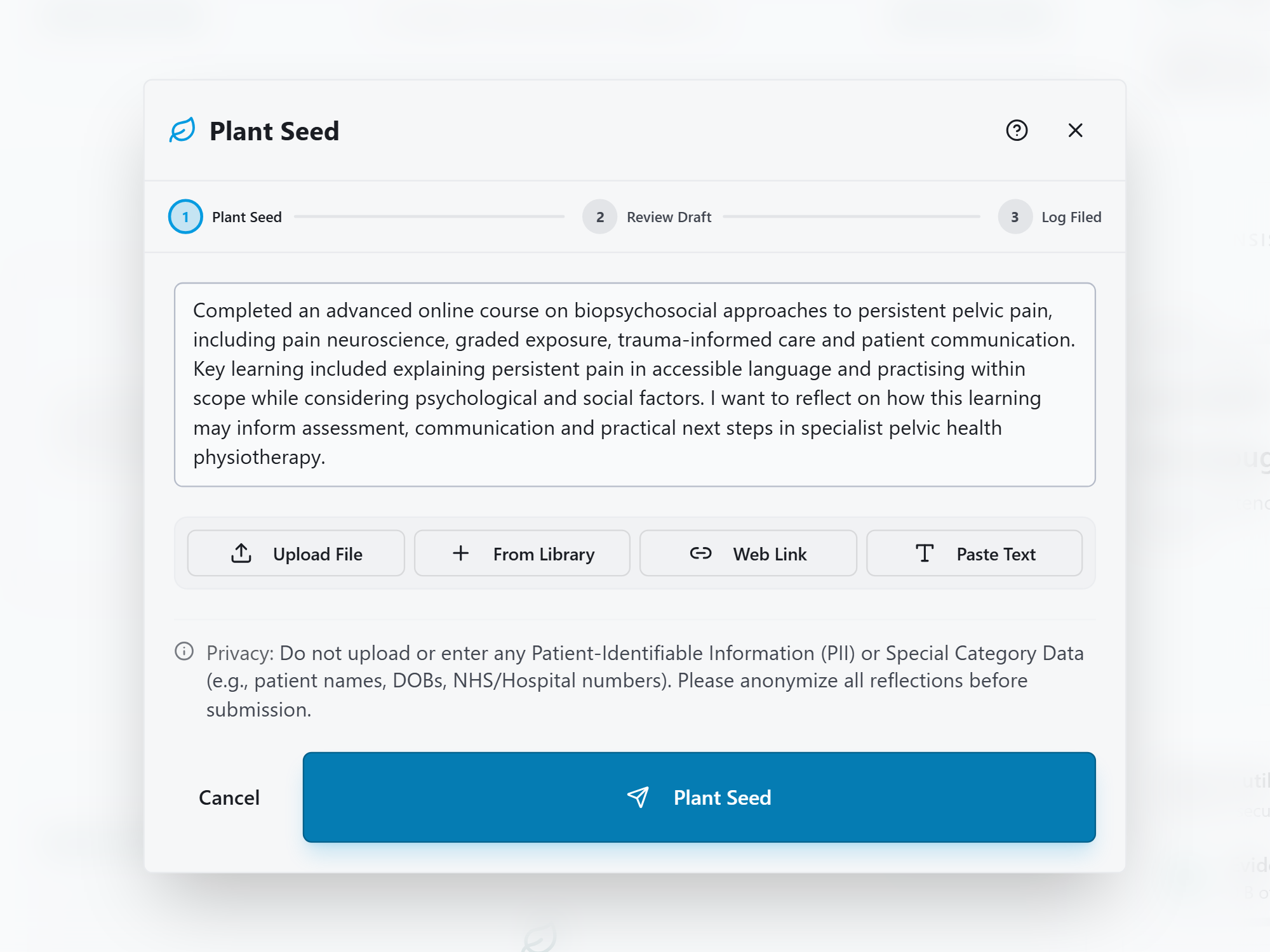
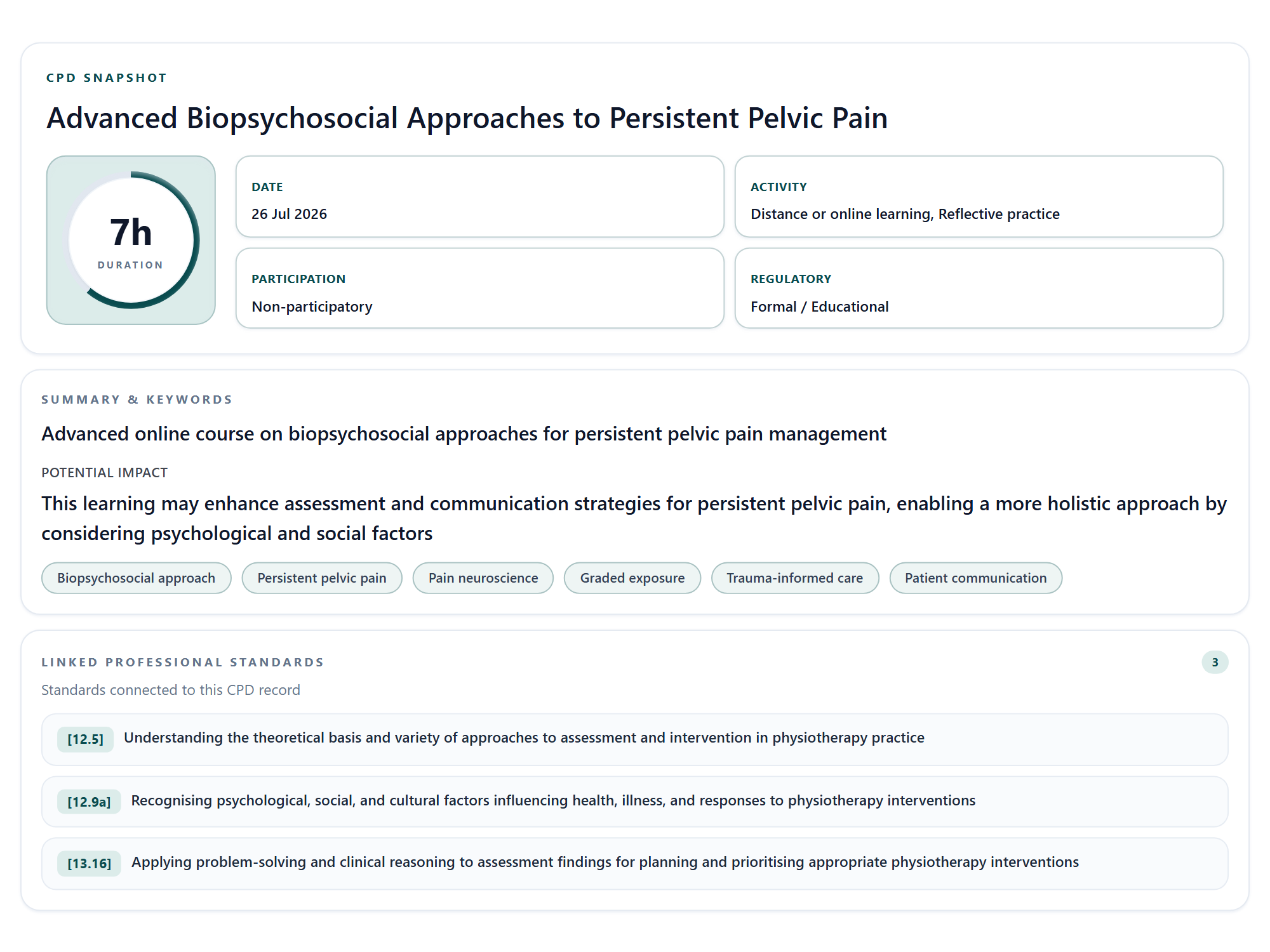
- Advanced online course: biopsychosocial approach to persistent pelvic pain.
- Topics include pain neuroscience, graded exposure, trauma-informed care and patient communication.
- Non-participatory distance learning over several hours.
Reflection focus
- Explaining persistent pain concepts in accessible language.
- Integrating psychological and social factors without reducing care to biomedical labels.
- Trauma-informed enquiry and scope-aware practice.
- Confidentiality and avoiding unnecessary identifiable detail in records.
- Supporting people with complex, long-term pelvic pain presentations.
Example ways this learning could be applied in practice
These illustrative points show one possible direction for applying the learning. Adapt them to your own role, scope and experience rather than copying the wording.
- I developed a clearer understanding of biopsychosocial reasoning and pain science for persistent pelvic pain.
- I would explain persistent pain concepts in more accessible language and use trauma-informed enquiry where appropriate.
- I identified ways to consider psychological and social factors in collaborative assessment and planning while staying within my scope.
- This could help me support people with complex presentations while keeping records confidential and free from unnecessary identifiable detail.
- My next step would be to embed selected learning through supervision or local governance discussion before changing practice routines.
How HandyCPD helps turn this learning into an organised CPD record
Valuable learning is easy to forget and much harder to evidence later. HandyCPD helps you capture it while it is fresh, then keep your CPD records, evidence and reflections together in one organised digital portfolio. AI-supported prompts make drafting and structuring easier, while Analytics helps you see themes and gaps as your learning grows. You remain in control of every record, with everything easier to review and retrieve if you are selected for audit.
For this activity, HandyCPD could help connect pain science and trauma-informed learning with communication, scope-aware practice and practical next steps.
Walkthrough in HandyCPD
Step 1: Plant a Seed
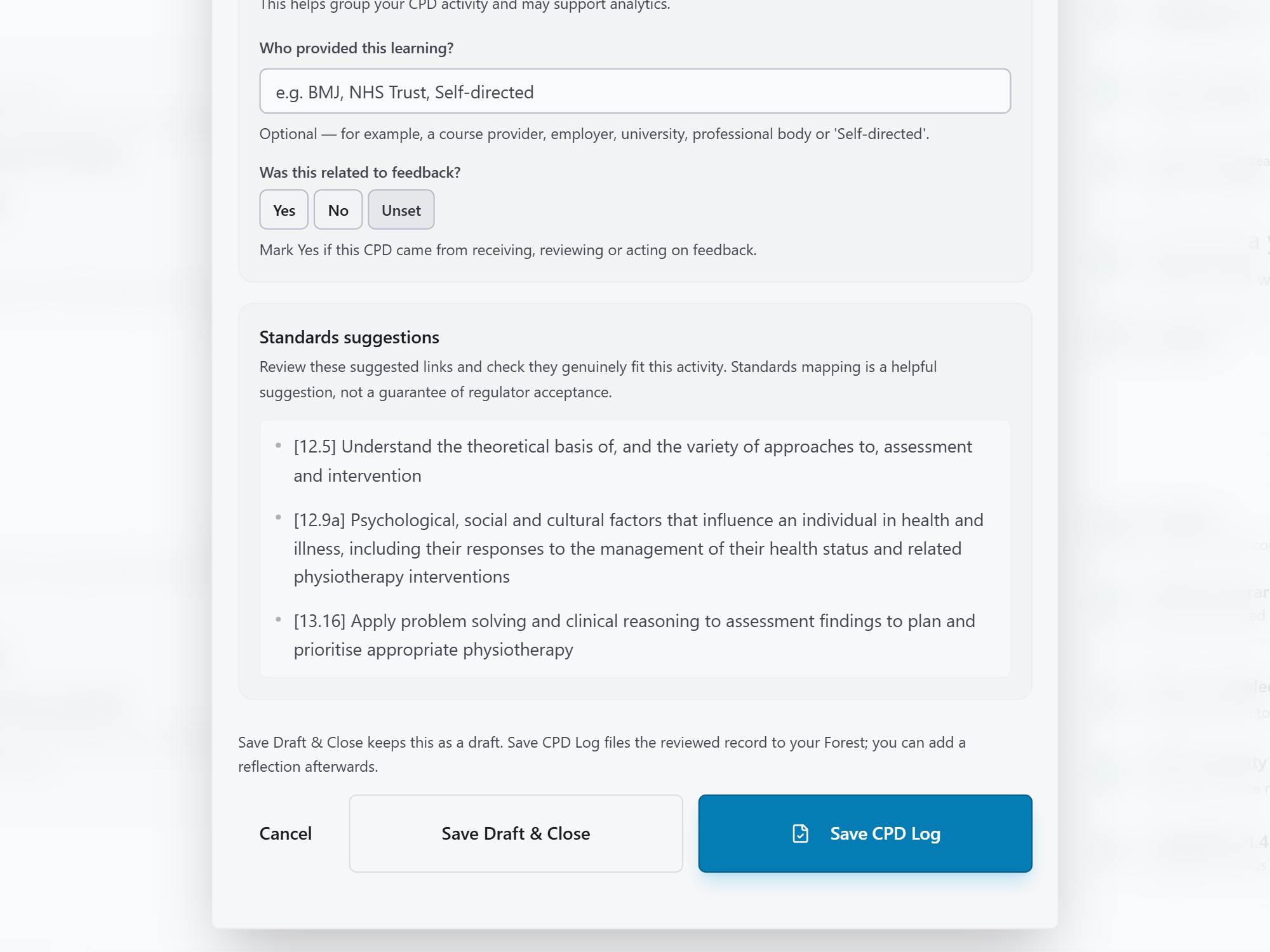
Step 2: Review and file your CPD log
Step 3: View your CPD Snapshot
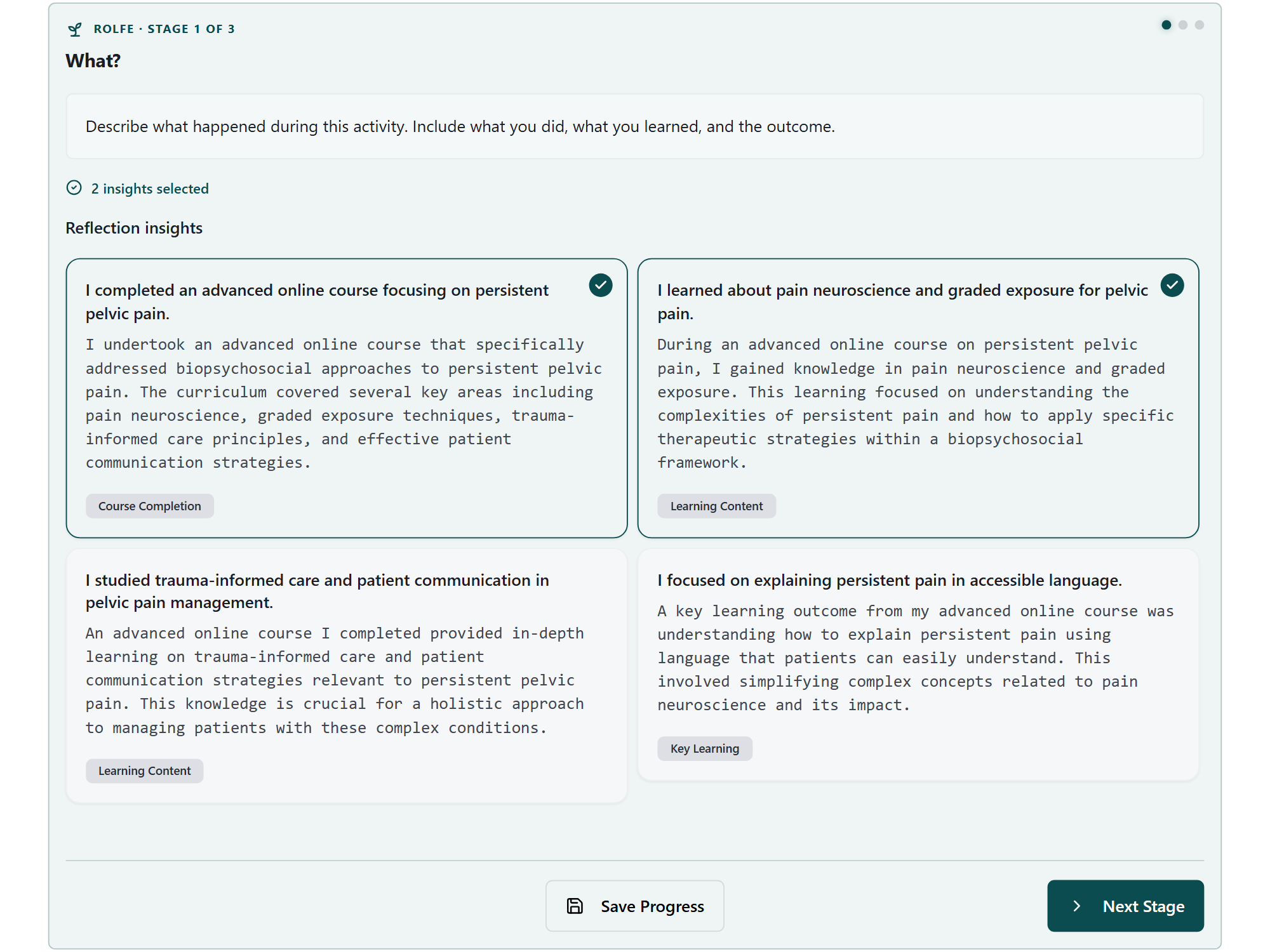
Step 4: Develop a fuller reflection when useful
Physiotherapy CPD examples FAQ
Can I copy these physiotherapy CPD examples?
No. They are fictional examples for learning support only. Use them to understand structure, then write your own CPD record based on your role, scope, learning, evidence and professional judgement.
Do physiotherapists need CPD for HCPC?
UK physiotherapists are HCPC registrants and must meet HCPC CPD requirements. For general expectations and how to prepare records, see our HCPC CPD guide and the official HCPC resources linked below.
What should a physiotherapy CPD reflection include?
It should explain what you learned, why it mattered, how your thinking or practice changed, how it may benefit patients or service users where relevant, and what you will do next. For broader reflection writing guidance, see how to write a CPD reflection.
Can HandyCPD be used as a physiotherapy CPD portfolio?
HandyCPD can help organise CPD records, reflections, evidence and learning insights in a portfolio-style workflow. You remain responsible for checking, editing and approving records before relying on or sharing them.
Are these examples suitable for CSP or HCPC submissions?
They are educational examples, not official templates or guaranteed submission wording. Check current HCPC and CSP guidance, adapt records to your own practice and avoid identifiable or confidential information.
Ready to build physiotherapy CPD records like these examples?
Follow the same workflow with your own anonymised learning. You review every record before filing.
30-day Pro trial. No card required.